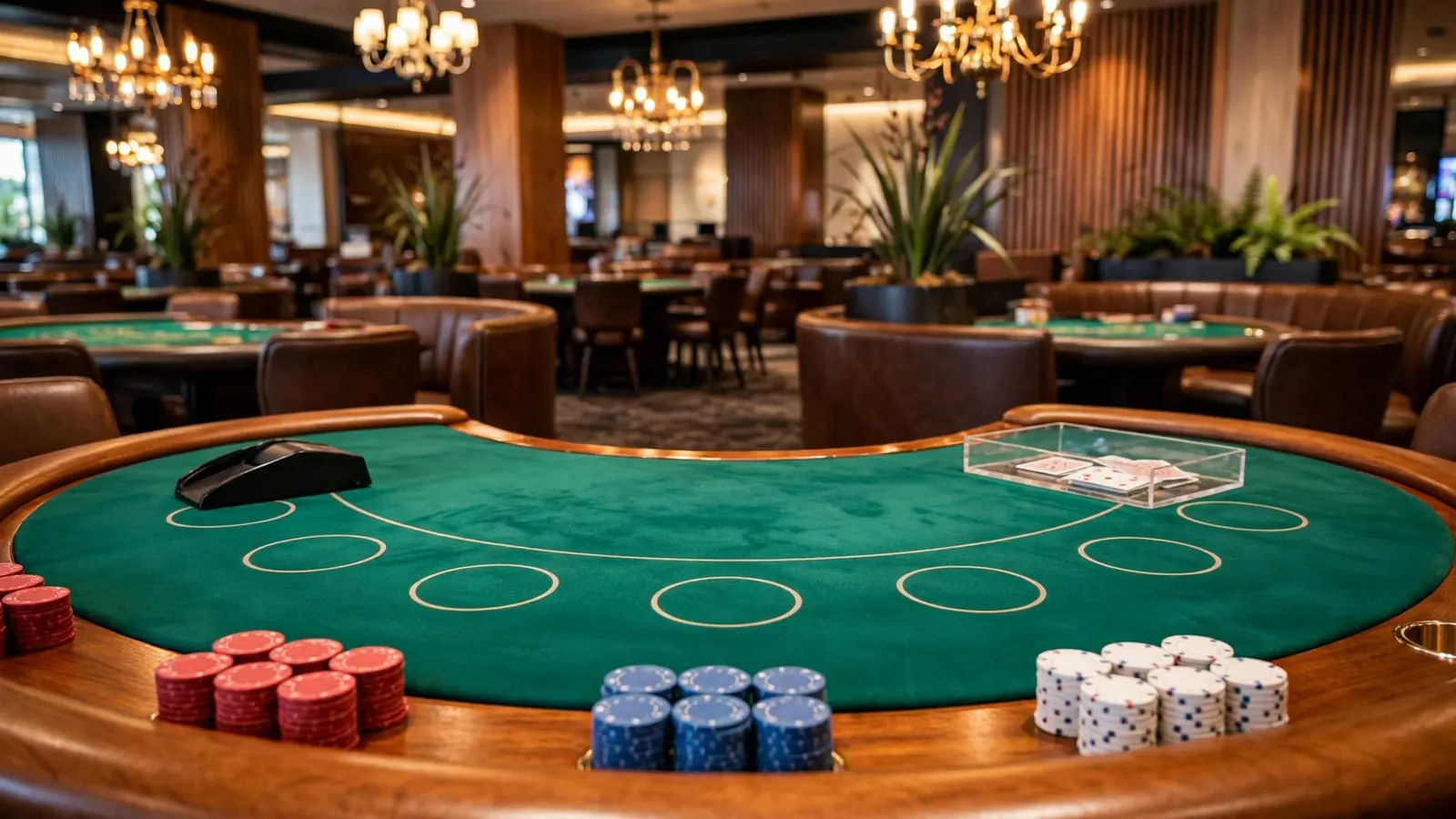
Live Dealer Blackjack in New Zealand: How It Works
 Available in US
Live blackjack pairs physical cards with an online stream, while delays and stake conditions shape the remote table experience.

Table of Contents
- How Live Dealer Blackjack Works in New Zealand
- Choosing a Live Table: Rules Matter More Than a Counting System
- What to Check on a Live Blackjack Site
- Real-Money Play: Payouts, Bonuses and the Final Calculation
- The Decisions at the Table: Hit, Stand, Double or Split
- Live Blackjack Rules Vary by Table
- Real-Money Blackjack Payouts: 3:2 or 6:5
- Free Play Versus a Live Table
- Blackjack Variants and Free-Bet Conditions
- The Value of Each Hand: Cards, Aces and Insurance
How Live Dealer Blackjack Works in New Zealand
Live-dealer blackjack combines a physical card game with an online stream. A dealer handles actual cards at a casino table, while players follow the hand remotely through video. The format differs from a game run entirely by software: the cards in a live game are physical, but the stream is the route by which the table is seen. That distinction does not remove the practical effects of playing online. A delay in the broadcast can slow the hand, and some live tables may require higher bets than a player expects.
The table experience is therefore a combination of two things: the blackjack dealt in front of the dealer and the digital service carrying it to the player. The cards are real; access is mediated by a screen. That can make a live game feel closer to a casino table than a software game, but it does not make the online setting equivalent in every respect. A stream can add waiting time, and the available stake conditions may differ from those at other tables. Those are operating features of the format, not details that can be inferred from the phrase “live dealer”.
For live dealer blackjack in New Zealand, checking the available operator details can help you decide which options to explore further. This list provides a concise reference to the information supplied for each operator.
License: Malta Gaming Authority, licence no. MGA/B2C/394/2017 N1 Casino is listed with a Malta Gaming Authority licence, number MGA/B2C/394/2017.
License: Curaçao Gaming Authority, licence no. OGL/2024/165/0185 BitStarz is listed with a Curaçao Gaming Authority licence, number OGL/2024/165/0185.
License: Tobique Gaming Commission, licence no. 0000064 Neospin is listed with a Tobique Gaming Commission licence, number 0000064.
Payout speed: 1-3 business days Lamabet’s stated payout speed is 1-3 business days.
License: Tobique Gaming Commission, licence no. 0000091 7Bit Casino is listed with a Tobique Gaming Commission licence, number 0000091.
License: Tobique Gaming Commission, licence no. 0000002 Ricky Casino is listed with a Tobique Gaming Commission licence, number 0000002.
License: 07017519840 · Payout speed: 1-3 business days Zotabet has the listed licence identifier 07017519840 and a stated payout speed of 1-3 business days.
License: Malta Gaming Authority, licence no. MGA/B2C/370/2017 Play Grand is listed with a Malta Gaming Authority licence, number MGA/B2C/370/2017.
Payout speed: 1-3 business days Wintino’s stated payout speed is 1-3 business days.
In New Zealand, the regulatory setting also changed during 2026. Before the new law, online casino gambling supplied from outside the country was not licensed or supervised by a New Zealand regulator. A customer using an offshore website in that period had no domestic government recourse. The Gambling Act 2003 did not permit online casinos to be based in New Zealand, and domestic online casinos were prohibited.
The Online Casino Gambling Act 2026 created the country’s first domestic licensing framework for online casino gambling and came into force on 1 May 2026. It does not mean that the full licensing system became operational immediately. Instead, the Act provides for a transitional period from 1 May to 1 December 2026. During that interval, online casinos that were already serving people in New Zealand before 1 May are permitted to continue operating under the transitional provisions.
That permission has a defined scope: it concerns providers already operating in the market before the Act took effect, rather than a general opening for any new service to enter. The transition is also temporary. The full licensed regime is expected to become operational in 2027, so the legal position during the transition should not be described as though the finished licensing system were already in place. Nor should the existence of a future framework be mistaken for proof that every online blackjack table is locally licensed in 2026.
Institutional responsibilities are divided. The Department of Internal Affairs is New Zealand’s primary gambling regulator and oversees regulation of the online casino licensing framework. The Gambling Commission handles the licensing decisions: it considers applications and determines them, issues online casino licences, and approves changes to licence conditions. In practical terms, the Department has the broader regulatory oversight role, while the Commission makes decisions about applications and licence conditions.

For a player assessing live dealer blackjack in New Zealand in 2026, the date matters. The market is moving from an era without domestic oversight of offshore online casino provision into a statutory licensing system, but the transition and the full regime are not the same stage. Existing providers may continue through the transitional window; the comprehensive licensed framework is not expected to be fully operational until 2027. A table being accessible online does not, by itself, establish its regulatory status.
The distinction between the table and the legal framework is useful. The live table describes how the game is delivered: actual cards, a dealer, and a stream that may introduce delay or higher betting requirements. The licensing framework describes how online casino gambling is regulated in New Zealand as the transition proceeds. One concerns the playing format; the other concerns the market’s legal structure. Neither should be used as a substitute for the other.
This is a period in which dates and status carry more weight than general labels. “Live dealer” identifies a format, not a licence. “New Zealand” may describe the intended audience, not necessarily where a provider is based or how it is authorised. The new law establishes a domestic route to licensing, while the transitional provisions preserve continued operation for qualifying existing providers until 1 December 2026. The finished regime remains a later stage. A clear reading of those distinctions is more useful than treating every live blackjack table as having the same local status.
Regulatory Transition
From 1 May to 1 December 2026, online casinos already serving New Zealand may operate under transitional provisions before the full licensing regime becomes operational in 2027.
Choosing a Live Table: Rules Matter More Than a Counting System
A live blackjack table is not defined by its camera feed alone. The rules determine how a hand is treated, and those terms can change the decisions available and the house edge. A table with a familiar layout may therefore offer a different game from another table carrying the same broad label. The useful comparison is not which table looks busiest, but what its rules allow and how those rules affect play.
A specialist review notes that live games can differ in deck count, the dealer’s procedure on soft 17, surrender availability and blackjack payouts. These details should be treated as table-specific rather than assumed from the game name. They are not cosmetic settings: a change in the rules can alter the value of a decision, so a strategy learned for one version may not transfer cleanly to another. A table is only comparable with another once the terms are known.
The dealer’s soft-17 rule is one example of a condition that can change the underlying game. Whether the dealer hits or stands affects how the hand proceeds in that situation, and therefore the conditions against which a player’s decisions are made. Surrender, where offered, changes the options available in a hand. Deck count is another variable to establish before attaching much weight to a system that assumes a particular dealing environment. The point is not to memorise a catalogue of rules; it is to avoid treating different games as interchangeable.

The natural-blackjack payout is also part of the table’s economics. A specialist review reports that some tables offer different payouts, including 3:2 and 6:5. That distinction has a direct effect on the return when a natural occurs, so a strategy discussion that ignores it is incomplete. The exact table terms matter more than a general claim that a game is “standard”. No single label resolves the calculation.
Card counting is a separate question. Mental card counting is not illegal under New Zealand law. That legal point does not make it a reliable way to choose a live table, nor does it establish that a count will improve results in a particular game. Counting is an attempt to use information about cards already dealt; its practical value depends on the game’s dealing and shuffling conditions. It cannot repair unfavourable rules or substitute for knowing them.
The distinction matters especially when an online game uses automatic shuffles. In RNG blackjack, software handles the shuffle and the pace is faster than at a live-dealer table. A count carried from one hand to the next should not be treated as a dependable basis for decisions where the cards are automatically reshuffled. Live play uses actual cards, but that alone does not establish that card counting is useful: the relevant question is how the table handles cards, not whether a dealer appears on screen. A counting system is not a guarantee, and no betting progression turns it into one.
- Establish deck arrangement and payout terms
- Check the dealer’s soft-17 procedure
- Verify surrender rule availability
- Assume rules are standard based on labels
- Rely on counting systems for automatic shuffles
- Treat different live tables as interchangeable
A practical comparison starts with the information that changes the game itself. Establish the deck arrangement, soft-17 procedure, surrender rule and payout before considering a strategy. Then judge whether the chosen strategy is built for those conditions. If a rule is unclear, the table cannot be assessed accurately; filling the gap with an assumption is not analysis. The rules are the inputs, and the result of any strategic calculation is only as sound as those inputs.
There is also a difference between choosing mechanics and choosing a format. RNG play offers software shuffles and faster hands; live play uses actual cards and proceeds at the table’s pace. Neither format makes every table equally suitable. A preference for a live dealer does not answer whether its rules fit a particular approach, just as faster play does not make an RNG game strategically equivalent. Speed is a feature of the format, not evidence of a better deal.
A table should therefore be judged on two separate grounds: whether its conditions are clear, and whether those conditions match the intended style of play. A player who wants to count cards still needs to account for the shuffle; a player who does not count still needs to account for the rules. Betting systems cannot compensate for a mismatch. When the dealing conditions and rules are understood, strategy can be considered on its actual merits rather than on the promise of a counting system.
What to Check on a Live Blackjack Site
A live table puts actual cards on screen, but the site still controls how clearly the conditions are presented. Before joining, the useful information is not a claim that the game is “authentic”; it is the table’s rules, betting terms and any delay between the studio and the displayed action.

Start with the table information panel or rules page. It should identify the number of decks, the dealer’s procedure on soft 17, whether surrender is available and the stated blackjack payout. A specialist review notes that these conditions can differ between live games. Treat a rule shown for one table as applying to that table only, rather than assuming it carries across a site. If the information is absent or difficult to reconcile with the game screen, the terms are not sufficiently clear to compare.
Streaming is another operating condition, not a decorative feature. A delayed picture can make the displayed action arrive after the decision window has moved on. The site should explain how betting and decisions work around the stream, and the interface should make the current hand and remaining decision time legible. A smooth video feed does not, by itself, establish that the game is running without delay.
The table’s betting range matters just as much as its rules. Live games may require higher bets than expected, so the minimum and maximum should be visible before a seat is taken. This is relevant to anyone looking for low-stakes live blackjack: the label is less useful than the actual limits shown for the specific table. A mobile layout should keep those limits and the rules accessible without hiding them behind controls that interrupt play. Mobile live blackjack remains a live stream; a smaller screen does not remove the table conditions.
Checking a Live Table
- Identify the number of decks used
- Confirm the dealer’s soft 17 procedure
- Check if surrender is available
- Verify the stated blackjack payout
- Review the minimum and maximum betting limits
- Assess the stream for potential delay
A practical check is to compare the lobby description with the rules attached to the table itself. The lobby may identify a game, while the table panel supplies the terms that determine how it operates. If those descriptions conflict, the table-level rules need to be clarified before play. The same applies when moving between tables: a familiar interface is not evidence that the next game has the same rules or betting range.
Promotional labels require separate scrutiny. A live blackjack no-deposit bonus, where offered, is not a statement of the cash value that can be withdrawn. The terms should show whether blackjack contributes differently to wagering requirements and what maximum-bet rules apply during wagering. A bonus headline without those conditions leaves the final calculation incomplete; the relevant terms belong alongside the offer, not behind assumptions about how all games are treated.
For real-money play, the operational checks are simple: confirm the table’s rules, visible limits and any delay information, then set a budget before joining. Stop when that budget is reached rather than increasing stakes to recover losses. The table may look like a casino floor, but the useful comparison is still between stated conditions and the amount at risk.
Real-Money Play: Payouts, Bonuses and the Final Calculation
With online blackjack for real money, the visible bonus is only one part of the financial terms. The result depends on the cash wager, the table’s payout rules and any conditions attached to bonus funds. A balance displayed on screen is not necessarily the amount available to withdraw: funds may remain subject to wagering requirements, and blackjack may contribute differently from other games.
The useful comparison is the amount that can be retained after the conditions are met, not the headline value of an offer. Before playing, the bonus terms should make clear which games qualify, how blackjack contributes to wagering requirements and whether a maximum-bet rule applies while wagering. A wager that exceeds that rule may affect eligibility for the bonus or its associated winnings. The exact consequence depends on the stated terms, so the rule needs to be read before play rather than reconstructed afterwards.
A simple calculation separates the cash position from the promotional one. Start with the amount deposited, then account for wins and losses at the table. Keep bonus funds and any winnings tied to them in a separate column until the wagering conditions and withdrawal rules are satisfied. If the terms do not explain how a live blackjack wager is treated, the bonus value cannot be calculated reliably. Treating the full advertised amount as cash would overstate what is available.
Payout wording also changes the final return. A specialist review describes natural blackjack payouts of 3:2 at some tables and 6:5 at others; that report should not be read as a guarantee about any particular table. The table’s own terms determine the applicable payout. For a real-money comparison, the stated rule matters more than the label attached to the game, because the same result can return different amounts under different payout terms.
The same discipline applies to bankroll decisions. A budget sets the maximum cash exposure; it does not make a bonus worthwhile or turn a loss into a recoverable amount. Once that budget is reached, continuing in an attempt to recover losses changes the exposure rather than improving the calculation. A sensible ledger records deposits, cash wins and losses, and bonus-related funds separately. That makes the final position visible without treating restricted funds as withdrawable money.
Attention A balance displayed on screen is not necessarily the amount available to withdraw, as funds may be subject to wagering requirements.
For online blackjack with live dealers, streaming does not alter the financial terms, but the table’s rules and any applicable bonus conditions still determine the result. Fine print should be checked on trustworthy sites and casinos before real-money play. The final figure is the cash balance that can actually be withdrawn after table results and valid conditions are accounted for—not the largest balance briefly shown on screen.
The Decisions at the Table: Hit, Stand, Double or Split
Live dealer blackjack is played against the dealer, not against the other people seated at the table. The aim is to finish with a hand closer to 21 than the dealer’s, without going over. Each decision changes the hand in a different way: taking another card, keeping the total as it stands, increasing the stake while limiting further play, or dividing a hand into separate ones.
Hit means taking another card. It can improve a low total, but it can also push the hand beyond 21, ending its chance of beating the dealer. The decision is therefore a trade-off between needing more value and risking a bust. A hit does not settle the hand by itself unless the new total exceeds 21; otherwise, another decision may follow.
Stand means taking no more cards. The hand stays at its current total and waits for the dealer’s result. Standing avoids the immediate risk of going over 21, but it does not improve a total that may already be behind. The choice rests on whether the existing hand is strong enough to leave the outcome to the dealer’s play.

Double down combines a larger stake with a narrower decision. The player adds to the original wager and receives one more card, then the hand is finished. That can make a favourable position more valuable, but it also commits more money before the final comparison. The relevant calculation is not simply whether another card would be welcome; it is whether the one-card limit and the increased stake make sense for that hand.
Split turns an eligible hand into two separate hands. Each is then played against the dealer on its own, so the decision creates two outcomes instead of one. Splitting also requires an additional wager under the table’s procedure. It can offer a better route than keeping the original combination together, but it exposes more money and does not guarantee that either resulting hand will finish ahead.
The action menu is straightforward; the consequences are not interchangeable. A hit changes the hand, a stand locks it, a double down commits additional money for one card, and a split creates another hand to resolve. Table rules can affect which actions are available and how they work, so the controls shown at the table matter before a choice is made.
A live stream presents these as timed decisions, but the objective remains the same: compare the completed hand with the dealer’s and stay at or below 21. Choosing an action is not a way to guarantee a win. A budget set before play, with no attempt to recover losses by increasing stakes, keeps the cost of those decisions bounded.
Taking another card to improve a low total, risking a bust if the total exceeds 21.
Keeping the current total and waiting for the dealer’s result to avoid the risk of going over 21.
Increasing the stake to receive exactly one more card before the hand finishes.
Dividing an eligible hand into two separate hands, each requiring an additional wager.
Live Blackjack Rules Vary by Table
A live blackjack table is defined not only by its dealer and cards but by the rules attached to the game. A specialist review reports variation in deck count, the dealer’s procedure on soft 17, surrender availability and blackjack payouts. These terms can alter the house edge and the decisions that make sense during a hand, so the table name alone is not a complete description.
Deck count affects the composition of the cards remaining in play. It can therefore change the probabilities behind particular hands and outcomes. That does not make a counting system a reliable answer to every variation: the practical value of any strategy depends on the rules and how the game is dealt. Two tables labelled blackjack may present different conditions even when the basic objective is unchanged.
The soft-17 rule concerns what the dealer does with a hand containing an ace counted as 11 and totalling 17. Under one procedure the dealer hits; under another the dealer stands. That single instruction affects the dealer’s possible final hands, which in turn affects the balance between player and house. It also means that a strategy based on one table’s procedure should not automatically be carried across to another.
Surrender is another rule-dependent option. Where permitted, it gives a player an additional choice beyond hitting, standing, doubling down or splitting. Where it is unavailable, that choice is removed. The value of surrender depends on the situation and the rest of the table rules; its presence is not an automatic improvement in every hand.

Payout terms also differ. A blackjack payout changes the return on a natural, so it affects the overall value of the game. The specific payout belongs to the table’s conditions, not to the general label “live blackjack.” It should be read alongside the other rules rather than treated as a minor display detail.
These variations interact. A rule that appears favourable in isolation may sit alongside another condition that changes the game’s overall balance. Blackjack variants can therefore require different strategic decisions and carry different house edges. Familiarity with the basic play sequence is not enough to establish that two tables are equivalent.
The useful comparison is between the complete rule sets: deck count, dealer action on soft 17, whether surrender is allowed, and the stated payout terms. If any of those differ, the games differ in ways that can affect both decisions and expected results. A live dealer does not make the rules standard; the table’s own conditions do.
Real-Money Blackjack Payouts: 3:2 or 6:5
A specialist review reports both 3:2 and 6:5 as possible payouts for a natural blackjack. These are table-specific terms, not a fixed return that can be assumed across live-dealer games. The relevant figure is the payout printed for the table being played.
Natural Blackjack Payouts
A 3:2 payout provides three parts profit for every two parts staked, while a 6:5 payout provides six parts profit for every five parts staked.
The ratios express the profit relative to the stake. At 3:2, the profit is three parts for every two parts staked. At 6:5, it is six parts for every five parts staked. Because the second ratio gives less profit for the same stake, a natural blackjack at a 6:5 table returns less than one at a 3:2 table. The difference is direct: it changes the amount paid on that hand, not the value assigned to the cards or the dealer’s procedure.
For blackjack real money live dealers, this distinction matters when comparing tables that otherwise appear similar. A clear stream and a familiar layout do not compensate for a lower natural-blackjack payout. Nor does the label “live dealer” establish which ratio applies. The displayed table rules determine the term.
The comparison should stay confined to natural blackjack. It does not mean that every winning hand receives the stated ratio; the payout term refers to the specific natural hand. Other winning outcomes are governed by the table’s own rules. Treating the ratio as a general return on all hands would overstate what it pays.
A compact comparison keeps the decision concrete:
| Stated natural-blackjack payout | Profit relative to stake |
|---|---|
| 3:2 | Three parts for every two staked |
| 6:5 | Six parts for every five staked |
The table’s stated payout is therefore part of the cost calculation before play begins. When two live-dealer games differ only in this term, the higher ratio produces the better return on a natural blackjack, while the lower ratio reduces it. No strategy can change the posted payout for that hand.
This is relevant whether a game is presented as real-money blackjack with live dealers or through a live-dealer interface on an electronic device. The format does not settle the payout. The operative figure is the one attached to the particular table, and an unclear or absent display leaves the return uncertain. A lower ratio is not a small design detail: it is a less favourable payment condition whenever the qualifying hand occurs.
Free Play Versus a Live Table
“Free” can describe a way to try blackjack without wagering, but it does not by itself identify how the game is generated. The distinction that matters is whether the cards are dealt by software or by a live dealer. Online RNG blackjack uses software shuffles and moves faster; live-dealer blackjack uses actual cards and a streamed table, which brings the pace closer to a casino table.

A free software game can therefore provide practice with the game’s basic flow, but its speed and presentation differ from a live stream. In a live game, the dealer handles physical cards on camera. The stream can introduce delays, and some live tables may require higher bets. Those are practical differences, not evidence that one format is more or less genuine.
A search for free live-dealer blackjack can also blur two separate questions: whether a table is available without a wager, and whether the game is live rather than software-based. The label alone does not settle either point. A game presented as live should involve a dealer and actual cards; a software game uses generated shuffles, even when its interface resembles a casino table.
The question of whether live blackjack is rigged cannot be answered from the streamed image alone. Seeing physical cards establishes the format, but it does not, by itself, establish how a game is operated or verified. Conversely, a software shuffle is not proof of manipulation. The format describes how cards are presented and dealt, not a guarantee about fairness.
Live Blackjack Essentials
- Live dealer format uses actual cards and streams, differing in pace from RNG software
- Table rules, including deck count and payouts, vary and determine the house edge
- Promotional bonuses are subject to wagering requirements and maximum-bet rules
- A fixed budget is essential to manage risk regardless of the game variant
For practice, the main trade-off is pace and presentation. RNG play is quicker, while a live table takes place through a stream and may run more slowly. A free option, where offered, should be understood on its own terms rather than assumed to reproduce every feature of a real-money live table. In particular, the existence of a free version does not establish that the same table conditions apply when money is involved.
Blackjack Variants and Free-Bet Conditions
A live blackjack variant is not merely a different name attached to the same deal. Its rules can change the decisions available to a player and the house edge, so a familiar strategy may not transfer unchanged from one table to another. The label alone is not enough to establish how a game works.
This matters when comparing live dealer blackjack games, including tables described as free-bet blackjack or free-bet variants. “Free bet” may refer to a feature within the game, while a casino promotion may use similar wording for bonus funds. Those are separate terms. The table rules explain how the game operates; the promotion’s conditions explain when any bonus funds can be used and what must happen before resulting winnings can be withdrawn.
A useful comparison starts with the published rules for each table, then checks whether the rules alter available decisions or the house edge. If the description leaves the effect of a special feature unclear, the expected value cannot be assessed from the title. A more attractive label is not a calculation.
Promotional funds require a separate check of wagering requirements, eligible games, blackjack contribution and maximum-bet rules during wagering. Blackjack may count differently from other games toward a wagering requirement, and a maximum bet can apply while that requirement is active. A bonus balance therefore does not equal withdrawable cash: the final amount depends on the conditions attached to it and whether play complies with them. The fine print should be checked on trustworthy sites and casinos before real-money play.

The same discipline applies to any claim that a variant is the best live dealer blackjack option. “Best” has no fixed meaning unless the comparison specifies the relevant rules and the conditions on the money. A table with a feature that suits one strategy may be less suitable under another set of rules; promotional value can also disappear if the wagering terms are restrictive.
Set a playing budget before starting, keep bonus funds distinct from personal funds in the calculation, and do not chase losses to meet a promotion’s conditions. A variant changes the terms of play, not the certainty of the result.
The Value of Each Hand: Cards, Aces and Insurance
A blackjack hand is valued by adding its cards, with the ace providing flexibility. Number cards count at face value, while jacks, queens and kings each count as ten. An ace can count as either one or eleven, depending on which value gives the hand a useful total without exceeding twenty-one.
That flexibility matters as cards are added. An ace counted as eleven can be treated as one if keeping it at eleven would push the hand over twenty-one. The same cards can therefore have different effective totals as a hand develops; the ace is not fixed at one value for the whole deal.
In blackjack with live dealers, understanding the total is the basis for judging the hand. It is also separate from the choice of what to do next: the hand’s value describes its current position, not a guarantee of how it will finish.
Insurance should not be treated as a routine addition to a hand. It is a separate wager, so its cost and possible return need to be assessed on their own rather than folded into the hand’s point total. For most players, avoiding insurance is the more prudent default; the fact that it is offered does not make it necessary.
The arithmetic itself is simple. The decision is not always so simple, particularly when an ace can be counted either way. Keeping the hand total clear prevents that flexibility from being mistaken for extra points that can be retained regardless of what follows.
What is card counting?
Card counting uses mental calculation to keep track of cards during blackjack.
Is card counting illegal?
No. Card counting using mental calculation is not illegal under New Zealand law.
Does blackjack always pay 3:2?
No. A natural blackjack often pays 3:2, but some tables pay 6:5.
Published by the Casino Slots Adviser NZ team.