Live Blackjack in New Zealand: Rules and Play
 Available in US
A practical guide to hand decisions, payouts, table terms, mobile play and the differences between live dealers and RNG blackjack.
Table of Contents
- The Deal, the Decisions and the Blackjack Payout
- Table Rules That Change the Price of a Hand
- Live Blackjack in New Zealand: The 2026 Licensing Transition
- Live Dealer or RNG: What Changes Between the Formats
- Free Play as a Way to Learn the Hand
- Playing Live Blackjack Online: Stakes, Terms and Limits
- Using a Phone for Live Blackjack
- Bitcoin Deposits and Blackjack Bonus Conditions
- Assessing a Live Blackjack Gamble Without a Guaranteed-Win System
- Card Counting at Live and Online Blackjack Tables
The Deal, the Decisions and the Blackjack Payout
Blackjack is a hand-by-hand contest against the dealer. The aim is to finish closer to 21 than the dealer without going over. A total above 21 loses, so each decision weighs the value of another card against the risk of exceeding the target.
Number cards count at face value, while jacks, queens and kings each count as 10. An ace can count as either 1 or 11, whichever keeps the hand’s total more useful without busting. That flexibility makes the ace valuable: a hand containing an ace can change its effective total as more cards are dealt.
The available decisions shape the hand. Hitting means taking another card; standing ends the player’s turn with the current total. Doubling down increases the wager while committing to one more card, and splitting separates a pair into two hands when the table permits it. These are choices within the hand, not guarantees of a favourable result. The dealer remains the opponent, and a strong-looking total can still lose if the dealer finishes closer to 21.
A natural blackjack is an ace and a 10-value card dealt as the opening two-card hand. It is distinct from reaching 21 after taking additional cards: the combination and timing matter because the table may attach a different payout to it. A specialist review reports a 3:2 payout at one table and notes that some tables instead offer 6:5. Those terms are not interchangeable. On an equal stake, 3:2 returns a larger profit for a winning natural than 6:5; the displayed payout is therefore part of the hand’s price, not a decorative rule.
The word “payout” can also cause confusion. A winning hand returns the original stake as well as its profit, while a quoted ratio describes the profit portion. The distinction matters when comparing tables: a natural may look identical on the cards but produce a different result under different payout terms. Ordinary winning hands and natural blackjacks should not be treated as though they necessarily receive the same calculation.
Following a hand requires only a few moving parts: card values, the target, the dealer as opponent, and the decision to take or refuse another card. The payout then determines what a natural is worth if it arrives. A table’s label alone does not settle that amount; its stated terms do.
Table Rules That Change the Price of a Hand
A blackjack table is not defined by its felt or dealer. Its rules determine how often a hand can be improved, when a player can limit a loss and what a natural blackjack returns. Two tables with the same cards can therefore offer different prices for the same decisions. Comparing the rules before play is more useful than relying on a general label such as live blackjack.
The number of decks matters because it changes the composition of the cards remaining in play. That affects the probabilities behind decisions and can alter the house edge. Deck count does not, on its own, establish that a table is favourable: it has to be considered alongside the other rules. A game with fewer decks can still have terms that reduce the value of a natural or restrict a useful option.
Soft 17 is another consequential point. A soft hand contains an ace counted as 11 without taking the total above 21. When the dealer has a soft 17, the table may require the dealer to draw or to stand. If the dealer draws, there is another chance for the dealer’s hand to improve; there is also a chance of going bust. The player’s decisions are affected by which rule applies, so a strategy based on one table should not automatically be carried over to another.
Surrender, where offered, gives a player a way to abandon a hand under the table’s conditions rather than continue it. Its availability and timing matter: it can change whether a difficult starting hand has an exit, but it does not make every weak hand a surrender. The option is not universal, and its value depends on the rules and the hand in question. Hit, stand, double down and split also remain choices whose suitability depends on the table’s structure, not simply on the cards in isolation.
- Compare deck count and surrender availability
- Check dealer action on soft 17
- Confirm the natural-blackjack payout
- Rely on a general table label
- Use one table’s strategy on another
- Assume a polished stream means favorable rules
Payout wording deserves particular attention. A natural blackjack is commonly associated with a return of 3:2, but a specialist review has described tables with a 6:5 payout as well. Those are distinct terms, not interchangeable ways of presenting the same return. The lower payout reduces what is received for a natural relative to the larger one, while the rest of the hand may be played under otherwise similar rules. That single line can change the financial comparison between tables even when the game appears familiar.
A useful comparison starts with the rules printed for the specific game: deck count, dealer action on soft 17, surrender availability and the natural-blackjack payout. Variants can differ across these points, affecting both strategy and house edge. A rules panel for one table does not establish the terms of another table, even within the same live casino. Terms should be checked in the game information and confirmed against the operator’s own published conditions before real-money play. A polished stream is not a substitute for a rule sheet.

Insurance is a separate wager offered in a situation involving the dealer’s exposed ace. It is not protection that improves the underlying hand; it is a bet on whether the dealer has a natural. For most players, taking insurance is a poor choice because the wager carries its own price and does not remove the original hand’s risk. The apparent reassurance is packaging; the separate wager still needs to justify itself on its own terms. Insurance should generally be avoided rather than treated as a routine response to the dealer’s ace.
Side bets are likewise separate from the main blackjack hand. Their presence does not show that the core game has better rules, and their terms should not be confused with the payout for a natural blackjack. The relevant comparison remains the full set of table conditions and the cost attached to each wager. In live blackjack online, a single hand may look straightforward, but the table’s rules decide what that hand is worth.
Live Blackjack in New Zealand: The 2026 Licensing Transition
Choosing a live blackjack site in New Zealand is easier when you can check the limited verified details available for each option. Use these notes as a starting point, and confirm any game or payment details directly with the operator.
License: Malta Gaming Authority, licence no. MGA/B2C/394/2017 The listed licensing detail is a Malta Gaming Authority licence, no. MGA/B2C/394/2017.
License: Curaçao Gaming Authority, licence no. OGL/2024/165/0185 The listed licensing detail is a Curaçao Gaming Authority licence, no. OGL/2024/165/0185.
License: Tobique Gaming Commission, licence no. 0000064 The listed licensing detail is a Tobique Gaming Commission licence, no. 0000064.
Payout speed: 1-3 business days The stated payout speed is 1–3 business days.
License: Tobique Gaming Commission, licence no. 0000091 The listed licensing detail is a Tobique Gaming Commission licence, no. 0000091.
License: Tobique Gaming Commission, licence no. 0000002 The listed licensing detail is a Tobique Gaming Commission licence, no. 0000002.
License: 07017519840 · Payout speed: 1-3 business days The listed licence identifier is 07017519840, and the stated payout speed is 1–3 business days.
License: Malta Gaming Authority, licence no. MGA/B2C/370/2017 The listed licensing detail is a Malta Gaming Authority licence, no. MGA/B2C/370/2017.
Payout speed: 1-3 business days The stated payout speed is 1–3 business days.
The legal position for online casino services in New Zealand changed in 2026. The Online Casino Gambling Act 2026 created the country’s first domestic licensing framework for online casino gambling. That framework is being introduced in stages, so the position during the transition is not the same as the intended position once the full regime is operating.
The Act took effect on 1 May 2026 and set a transitional period that runs until 1 December 2026. During that window, providers that were already serving people in New Zealand before the Act began may continue to operate, subject to the transitional provisions. This is a limited continuation arrangement, not evidence that every online casino has obtained a New Zealand licence.
What the regulators do
The Department of Internal Affairs is New Zealand’s primary gambling regulator and oversees the online casino licensing framework. The Gambling Commission has specific decision-making responsibilities within that framework: it hears and determines casino licensing applications, issues online casino licences and approves changes to licence conditions.
Those roles are related but distinct. The Department oversees the framework; the Commission makes licensing decisions and handles changes to the conditions attached to a licence. The presence of a live dealer does not itself establish a provider’s licensing status.
Licensing Roles
The Department of Internal Affairs oversees the online casino licensing framework, while the Gambling Commission handles applications, issues licences, and approves changes to conditions.
The new framework also changes the legal basis on which online casino services may be offered domestically. Under the Gambling Act 2003, online casinos could not be based in New Zealand. Before the 2026 Act, online casino gambling supplied from outside the country was not licensed or supervised by a New Zealand regulator. A customer who wagered through an offshore website during that period had no domestic government recourse.
That history matters when assessing statements about regulation. An offshore service could be accessible to people in New Zealand without having been licensed by a New Zealand authority. Accessibility and domestic regulatory oversight are separate questions; one did not establish the other.
The transition and the application process
The transitional provisions allow qualifying existing providers to keep operating while the licensing regime is introduced. The permission is time-limited: providers already serving the New Zealand market before 1 May 2026 may continue until 1 December 2026. Providers that have not applied for a licence must cease conducting online casino gambling in New Zealand by that date. If an application is declined, the provider must stop its online casino operations in the country and leave the market.
An application is therefore not the same as an issued licence. The Gambling Commission is responsible for deciding applications, and the outcome determines whether a provider can proceed under the licensing framework beyond the transition. The transitional permission should not be read as a permanent approval, nor should an application alone be treated as proof that a licence has been granted.

The full licensed regime is not expected to be fully operational until 2027. Unlicensed operation is expected to become an offence from around mid-2027. These milestones describe different stages: the transition ends in 2026, while the complete licensing system and the expected offence provisions follow on a later timetable. Treating them as one event would blur the difference between temporary permission, an application decision and the mature regulatory regime.
Advertising and compliance during the changeover
Advertising restrictions also apply during the transition. Providers are prohibited from advertising online casino gambling to people in New Zealand during this period. Once licensed, operators may advertise only within tight rules, and sponsorships are prohibited. These restrictions are separate from the question of whether a provider may continue operating under the transitional provisions.
The new regime requires licensed operators to use stricter age and identity verification systems. That is a compliance responsibility for operators, not a feature that can be inferred from a blackjack game’s presentation or dealer stream. A polished live table does not, by itself, show that the operator has met the licensing requirements.
For New Zealand’s live blackjack market in 2026, the practical distinction is between a provider continuing under the temporary transition and one operating under a licence issued through the new system. The Department of Internal Affairs oversees the framework, while the Gambling Commission determines applications, issues licences and approves changes to licence conditions. Until the transition and licensing process have run their course, those categories should not be treated as interchangeable.
Unlicensed Operation
Unlicensed operation is expected to become an offence from around mid-2027 following the conclusion of the transitional and licensing periods.
Live Dealer or RNG: What Changes Between the Formats
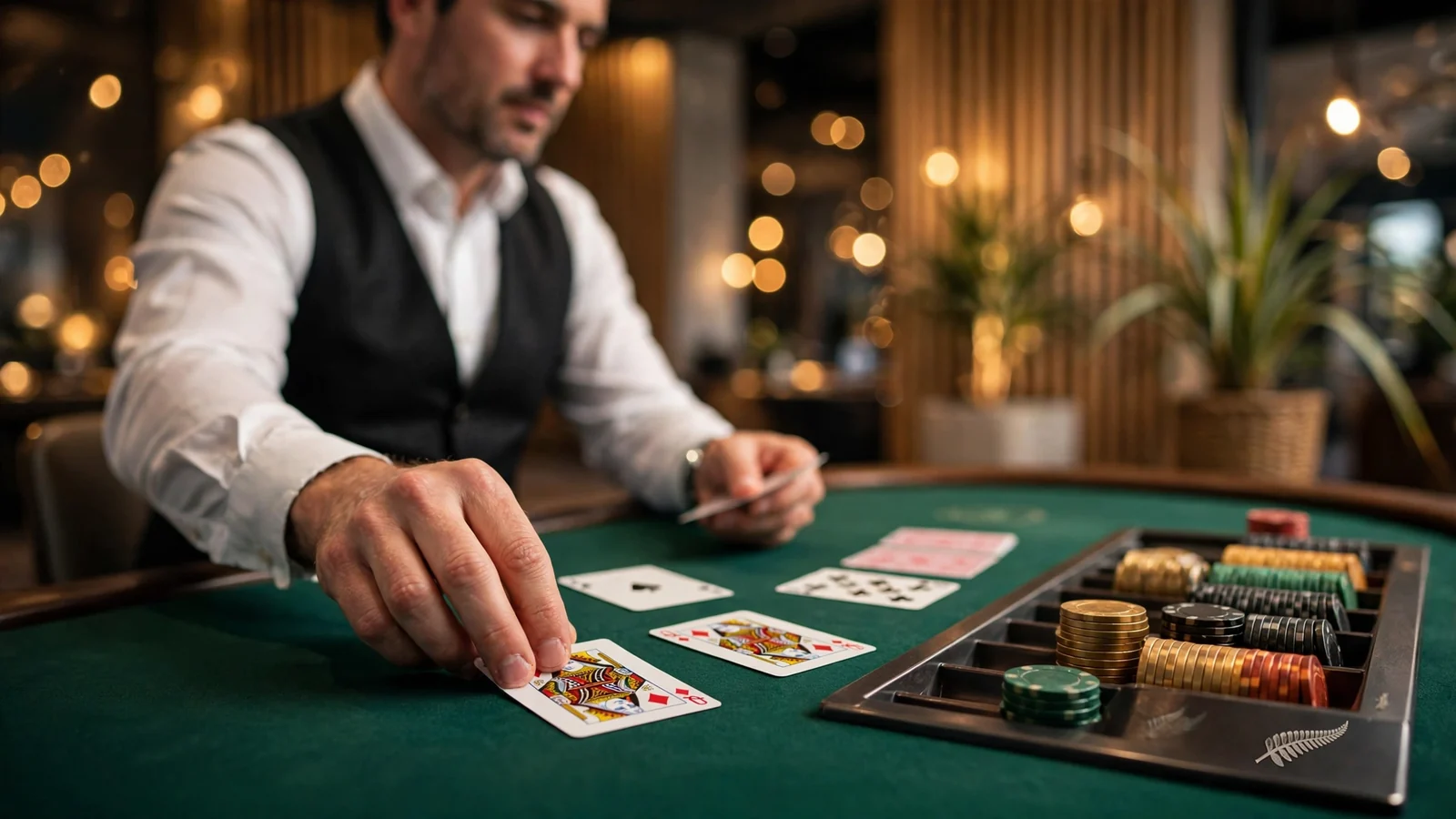
The main difference is how the cards reach the screen. In live-dealer blackjack, a dealer handles actual cards at a casino table and the action is streamed to players. In RNG blackjack, software determines the cards using a digital shuffle. Both present a blackjack hand, but the process behind it changes the pace and the viewing experience.
Actual cards and a streamed table
A live table gives the game a physical setting: cards are dealt, handled and shown by a dealer. The stream lets players follow that action as it happens, rather than seeing a sequence generated entirely by software. For someone comparing live blackjack with an RNG game, this is the defining distinction—not a different objective, but a different way of producing and presenting the hand.
That format depends on a working stream. A delay can separate an action on screen from the moment it reaches the player, making the game feel less immediate. The dealer’s pace and the streamed presentation also mean that live blackjack does not move as quickly as software dealing. A physical table adds the element of watching a dealer, but it also adds time between stages of play.
The resemblance to a casino table is therefore about the use of actual cards and a dealer, not a promise that every part of the online experience matches being there in person. The stream remains an intermediary. If it lags, the physical dealing does not make the online connection faster.
Software shuffles and quicker rounds
RNG blackjack uses software shuffles and can move through hands faster than a live-dealer game. There is no streamed dealer action to watch, so the digital format can present decisions and outcomes at a quicker pace. That speed can make the session feel more continuous, while live play has pauses associated with the dealer and the stream.
The trade-off is straightforward: faster software-led play reduces waiting, while live play shows actual cards being dealt. Neither format is automatically preferable. The relevant difference depends on whether speed or a physical table presentation matters more to the session. Faster rounds also mean more decisions can arrive in less time; pace is a feature of the format, not evidence that the game has become more favourable.
The digital shuffle should not be confused with a dealer shuffling physical cards. In RNG play, software handles the shuffle; in live play, the cards are real and the dealing is streamed. The distinction is clear even when the screen layout makes both games look similar.
The practical cost of the live format
Live tables may require higher bets than RNG tables, so the format can affect the amount needed to take part as well as the pace. That is a practical difference, not a guarantee of a better or worse result. The streaming delay is another cost in time: the live presentation may feel closer to a casino table, but it cannot remove the lag of an online stream.
For live blackjack in New Zealand, the choice is between a streamed game with actual cards and a software-driven game that moves faster. The comparison is best made on those terms: physical dealing and possible stream delays on one side; software shuffles and quicker play on the other. The hand remains blackjack in either format, but the route from shuffle to screen is not the same.
Uses actual cards and a streamed table, providing a physical setting but introducing potential stream delays.
Uses software shuffles and digital dealing, allowing for a quicker pace and more continuous play.
Free Play as a Way to Learn the Hand
Free blackjack practice is useful for learning the flow of a hand without placing a real-money wager. Where a free mode is available, it can make the interface familiar: cards appear, a decision is selected, and the hand continues. That removes the cost of mistakes while the sequence is still being learned. It does not make the practice table identical to a live-dealer game.
A useful session has a narrow purpose. Follow each hand from the initial deal to its result, and notice when the available choices change. The central actions are hit, stand, double down and split. Practice can help make their controls familiar and show how an action affects the hand on screen. The point is not to click quickly, but to understand what the interface is asking before making a choice.
Free play is also a place to pause and review a decision. A hand can be replayed or considered without the pressure of a live wager, if the game provides that option. The value lies in building familiarity with the layout and decision points, not in producing a record of wins. Results in a short practice session do not establish that a strategy is profitable or predict what will happen in a later game.

The label “free” does not identify how the game is run. Some online blackjack uses software shuffles; a live-dealer table uses actual cards. A free version may therefore help with the general rhythm and available actions while leaving out the streamed dealer experience. Even when the rules and screen resemble a live table, practice should not be treated as a rehearsal with identical pace, presentation or conditions. Those differences matter because familiarity with buttons is not the same as experience of a particular table.
A practical way to use free play is to set a learning task before starting. For instance, focus on recognising the decision options, or follow how the hand changes after each selection. Keep attention on the decision process rather than the displayed result. A favourable outcome does not prove that a choice was sound; an unfavourable one does not, by itself, prove the reverse. Blackjack hands can vary, while the interface remains something that can be learned.
Free online access can also reveal whether the format is understandable before any real-money play is considered. If the rules, controls or hand progression remain unclear, the practice has identified a gap without charging for it. That is a modest return, but a measurable one: better familiarity with the mechanics, not a forecast of winnings and not a substitute for a live table.
Playing Live Blackjack Online: Stakes, Terms and Limits
Real-money live blackjack has two separate price sheets: the table’s rules and any promotion attached to the account. The first determines how a hand is settled; the second determines whether bonus funds can be used on blackjack and what conditions apply before a withdrawal. A headline offer cannot be assessed without both.
Bonus and Table Check
- Check the blackjack wagering contribution rate
- Confirm the maximum bet permitted during wagering
- Verify eligible games for the promotion
- Review the natural blackjack payout (e.g., 3:2 vs 6:5)
- Set a fixed session budget
Before accepting a bonus, the terms should be checked for blackjack’s wagering contribution, any maximum bet during wagering, eligible games and the conditions for withdrawing funds. Contribution matters because a game may count less towards wagering requirements than another eligible game. A maximum-bet rule can also make a normal table stake incompatible with the offer. If either condition is unclear, the bonus value cannot be calculated reliably; treating the displayed amount as cash would overstate what is available.
Table rules also affect the amount returned on a winning hand. A specialist review reports that a natural blackjack may be paid at 3:2 at one table and 6:5 at another. The number of decks, the dealer’s soft-17 decision and surrender availability can differ as well. These terms should be read on the selected table rather than inferred from a promotion or from another game with a similar name. A bonus does not correct an unfavourable payout.
The stake itself needs a limit set before play begins. A budget is the amount allocated to the session, not a target that must be recovered if the balance falls. Once that amount is spent, adding more money changes the original decision rather than repairing it. Chasing losses has no contractual mechanism that turns a later hand into repayment.
A practical check is to separate the planned cash stake from any bonus balance, then confirm which funds are being wagered and which rules apply to them. If the promotion requires wagering, the relevant question is not just how large the advertised bonus looks, but how blackjack contributes and whether the maximum-bet condition permits the intended stakes. If the offer imposes conditions that do not fit the planned session, declining it leaves the stake easier to track.
Choosing the best live blackjack option therefore means comparing the terms that affect the actual exposure: the table payout, the promotion’s contribution rules, and its bet restriction. A higher displayed bonus is not automatically more valuable, and a table label alone does not establish its payout. The useful comparison is the amount that can be wagered under the stated conditions, with a fixed session budget and no additional deposit after losses.
Using a Phone for Live Blackjack
A phone changes the viewing conditions, not the nature of the live table. The dealer handles actual cards, while the game reaches the player through a stream. That can resemble sitting at a casino table, but the resemblance depends on a connection that keeps the action moving. Streaming can introduce delays, so a decision may not appear on screen at the same moment it happens at the table.
The practical effect is a less continuous hand. A pause may be caused by the stream rather than by a change in the game, and the player has to distinguish between waiting for the picture and responding to the table. Small screens also leave less room to view the dealer, cards and controls together. If an interface makes those elements difficult to see, the convenience of using a phone has a cost in attention.
A suitable mobile setup is therefore less about a branded app and more about whether the live table remains legible and responsive on the device in use. The same test applies when a game opens in a browser: the label does not resolve a stream delay or make the controls clearer. A session should not be treated as smooth merely because the page loads. The dealer’s actions, the player’s available choices and the current hand need to remain understandable throughout.
Mobile Constraints
Streaming delays on phones can separate the on-screen action from the actual table event, and smaller screens may obscure dealer and card visibility.
Bet requirements are another constraint. Live tables may require higher bets than a player expects from other blackjack options. On a phone, that matters because the format can combine a higher entry point with delays that interrupt the rhythm of play. A polished screen does not change either condition. Before joining a table, its displayed betting terms should be clear; if they are not, there is no useful basis for deciding whether the session fits.
Searching for the best live blackjack experience on a phone cannot produce a universal answer. Device size, stream performance and the table’s minimum stake all affect the practical result, and those conditions can differ between offerings. An app may be convenient to open, but convenience is not evidence of a reliable stream or suitable stakes. The relevant comparison is whether the live picture is clear, the controls are usable and the stated bet requirement is acceptable.
For mobile play, the stream is part of the table. If it lags or obscures the action, the phone has not made the game easier to manage; it has added another variable to the hand.
Bitcoin Deposits and Blackjack Bonus Conditions
A Bitcoin deposit and a live blackjack bonus are separate parts of the offer. The payment method determines how funds are sent and credited; the bonus terms determine what conditions attach to promotional funds. Neither should be treated as a single package with one predictable value.

Before transferring Bitcoin, check whether the casino accepts it for deposits and whether the same method is available for withdrawals. Read how the deposit is valued when credited to the account, whether conversion charges apply, and what happens if the amount received differs from the amount sent. The practical figure is the balance available for play after any deductions, not the value displayed before the transaction is processed. Payment terms should also state whether a Bitcoin-funded account qualifies for the promotion. If eligibility is unclear, the bonus value cannot be calculated reliably.
For a live blackjack bonus, the headline offer is only the starting point. The wagering requirements specify how much play is needed before bonus-related funds or winnings can be withdrawn. Blackjack may contribute differently from other games, so a term that counts play in another category cannot be assumed to apply in full at the live table. The contribution rate and any exclusions need to be checked in the promotion rules.
Maximum-bet rules matter during wagering as well. A hand played above the permitted stake may affect bonus eligibility or the associated winnings, depending on the stated terms. The relevant limit is the one in the bonus conditions, not a general assumption about what the table allows. If a promotion does not explain how live blackjack is treated, its advertised value remains uncertain.
The table itself has separate terms. A specialist review reports that some tables pay 3:2 for a natural blackjack while others pay 6:5; that is a report about specific games, not a guarantee about every table. The number of decks, the dealer’s soft-17 decision and surrender availability can also differ between games, as a specialist review notes. These differences affect the hand’s price independently of any bonus.
Comparing Bitcoin and Bonus Terms
Bitcoin deposits involve checking acceptance for withdrawals and conversion charges, while bonuses require assessing wagering requirements and maximum-bet rules. These are separate conditions; a Bitcoin-funded account may not automatically qualify for all promotions.
A useful comparison therefore starts with the net deposit credited, then accounts for bonus eligibility, blackjack’s wagering contribution and the maximum permitted bet. Only after those conditions are clear can the promotional balance be weighed against the table’s payout rules. If the rules leave a material term unstated, the prudent calculation assigns no value to that part of the offer.
Assessing a Live Blackjack Gamble Without a Guaranteed-Win System
A live blackjack wager is exposure to a hand whose outcome is not fixed by the previous one. The player competes against the dealer, aiming to finish closer to 21 without going over. Exceeding 21 means losing the hand, even if the dealer later also has a strong total. A favourable decision can still end in a loss; no betting pattern removes that possibility.
The useful calculation is therefore not a promised return but the amount at risk. A session budget sets the maximum planned exposure. A stop point defines when play ends, whether the session has gone well or badly. Without both, each additional wager can become a response to the previous result rather than a deliberate decision. Raising stakes to recover losses increases the amount at risk; it does not reverse the earlier result.
A so-called best live blackjack gamble is not a system that guarantees profit. The table remains a game against the dealer, and the final result depends on the hands dealt and the choices made during play. A rule for increasing or decreasing stakes may organise a session, but it cannot ensure that the next hand will compensate for an earlier loss.
A practical assessment separates the wager from the hope attached to it: the budget is the amount that can be lost, and the stop point is the boundary that prevents further exposure. If either is unclear before play starts, the financial decision has not been set. Once the budget is reached, continuing changes the original limit rather than improving the calculation.

Card Counting at Live and Online Blackjack Tables
Card counting is the mental tracking of cards that have already appeared, with the aim of estimating how the remaining cards may affect a hand. In New Zealand, using mental calculation for card counting is not illegal. That legal point does not establish that counting will produce a profit or that a particular table will permit every playing approach.
The format matters. A live-dealer game uses physical cards, so cards dealt during a shoe remain part of the information visible at the table. A count can therefore be updated as play proceeds, although the count is only an estimate of what remains. It does not predict the next card or remove the uncertainty of the deal.
Online RNG blackjack works differently. The software shuffles the cards, and games can move through hands faster than live-dealer tables. With software shuffles, cards from completed hands do not provide a dependable running count for the next deal. Treating an RNG game as though it were a continuing physical shoe confuses two different processes; faster play does not make the information more useful.

For live blackjack online, the stream shows a dealer handling actual cards, but the digital display does not change the underlying limits of a count. The count reflects cards already dealt, not cards hidden from view, and it cannot guarantee a favourable outcome. A mental calculation may be lawful while still being an uncertain basis for a wagering decision.
The practical distinction is narrow: card counting relates to the sequence of physical cards, whereas RNG play relies on software shuffles. Neither the lawfulness of mental calculation nor the presence of a live stream should be mistaken for evidence of a reliable winning method. In online games with automatic software shuffles, counting should not be presented as an effective way to gain an edge.
Is card counting illegal?
No. Card counting using mental calculation is not illegal under New Zealand law.
Does blackjack always pay 3:2?
No. A natural blackjack may pay 3:2 or 6:5, depending on the table; check its stated payout before playing.
Is insurance a good bet?
Generally, no. Insurance is a separate wager on whether the dealer has a natural and is usually best avoided.
Prepared by the Casino Slots Adviser NZ editorial staff.