Blackjack Tables in New Zealand: Rules and Play
 Available in US
Each player competes against the dealer, while table rules determine how hands are played and compared.
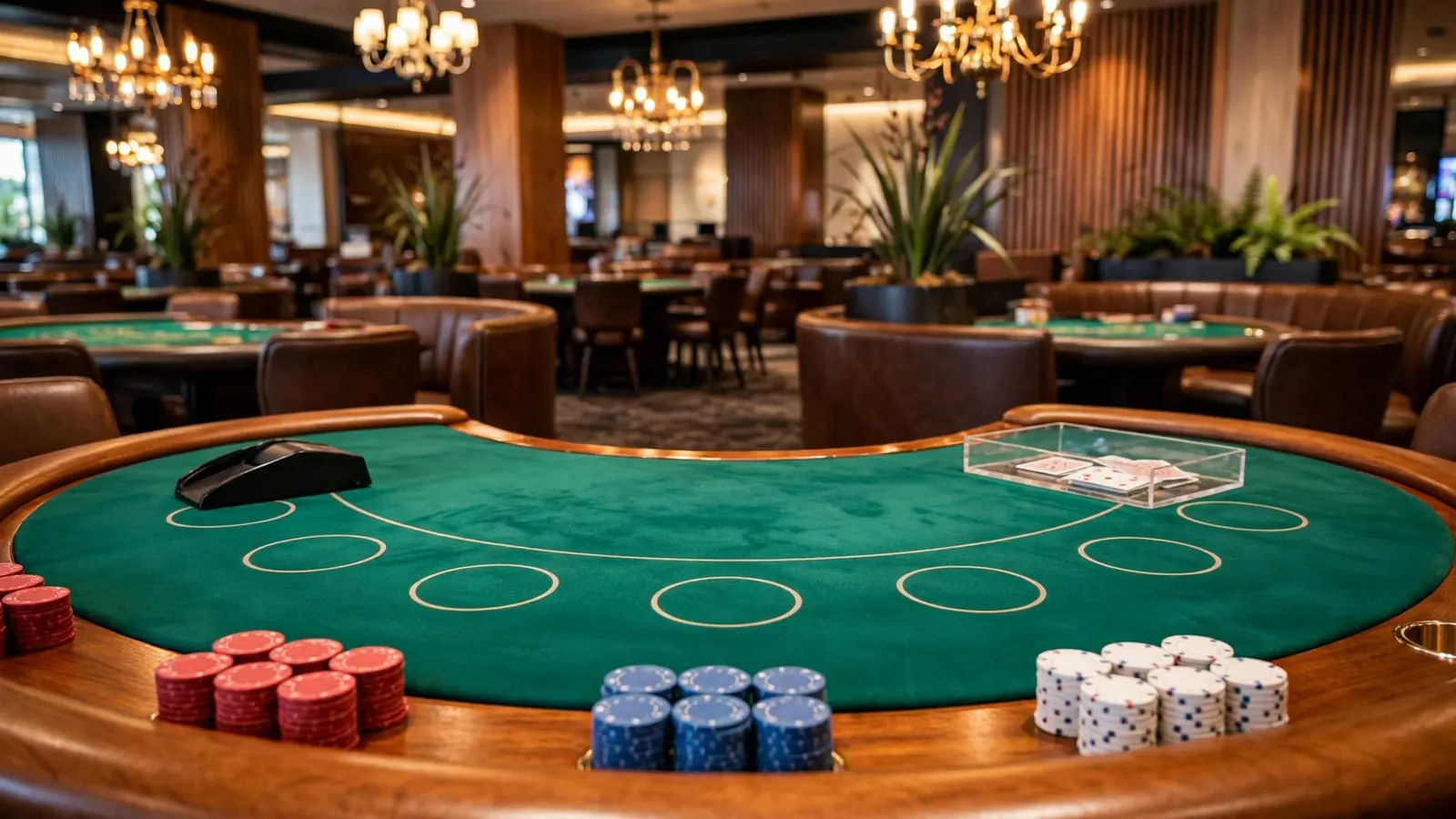
Table of Contents
- How a Blackjack Table Works
- Table Rules, Soft 17 and Blackjack Payouts
- Online Blackjack Tables and New Zealand’s Licensing Framework
- Strategy Depends on the Rules in Play
- Bets, Chips and Electronic Tables
- When to Hit, Stand or Take Another Action
- Choosing a Seat at a Live Blackjack Table
- Reading a Blackjack Card Chart
- What a Blackjack Cheat Sheet Can—and Cannot—Show
- Blackjack Table Limits and Rule Variations
How a Blackjack Table Works
Blackjack is a contest between each player’s hand and the dealer’s hand. The target is to finish closer to 21 than the dealer without going over 21. It is not a contest in which players try to beat one another: several people can sit at the same table, but each hand is measured against the dealer’s result.
That distinction explains the table’s basic arrangement. The dealer represents the house, while the people seated around the table play separate hands. A player’s result depends on how that hand compares with the dealer’s, not on the value of a neighbour’s cards. The shared table provides a common setting for the round; it does not turn the players into opponents competing for a single winning hand.
A physical casino table is the most direct version of that setting. Players and dealer occupy the same space, and the cards are present at the table. The dealer conducts the game there, while players take part from their positions around the table. The felt surface, cards and seats are practical parts of the setting, not clues that change the central objective: beat the dealer’s total without exceeding 21.
Choosing a blackjack table in New Zealand involves more than the game itself, so it helps to check what is known about each listed operator. Use these short verdicts as a starting point when reviewing the options.
License: Malta Gaming Authority, licence no. MGA/B2C/394/2017 N1 Casino is listed with a Malta Gaming Authority licence, number MGA/B2C/394/2017.
License: Curaçao Gaming Authority, licence no. OGL/2024/165/0185 BitStarz is listed with a Curaçao Gaming Authority licence, number OGL/2024/165/0185.
License: Tobique Gaming Commission, licence no. 0000064 Neospin is listed with a Tobique Gaming Commission licence, number 0000064.
Payout speed: 1-3 business days Lamabet’s stated payout speed is 1–3 business days.
License: Tobique Gaming Commission, licence no. 0000091 7Bit Casino is listed with a Tobique Gaming Commission licence, number 0000091.
License: Tobique Gaming Commission, licence no. 0000002 Ricky Casino is listed with a Tobique Gaming Commission licence, number 0000002.
License: 07017519840 · Payout speed: 1-3 business days Zotabet is listed with licence number 07017519840 and a stated payout speed of 1–3 business days.
License: Malta Gaming Authority, licence no. MGA/B2C/370/2017 Play Grand is listed with a Malta Gaming Authority licence, number MGA/B2C/370/2017.
Payout speed: 1-3 business days Wintino’s stated payout speed is 1–3 business days.
The phrase “blackjack table” can also describe an online game presented as a table. The screen may show a dealer and a table surface, but appearance alone does not establish how the game is being dealt. In a live-dealer game, actual cards are used and the action is streamed. That makes the experience comparable to a casino table, although it is viewed through a screen rather than from a seat in the room.
The stream adds a practical difference. A physical table can be watched directly; a live online table depends on video reaching the player. Streaming may introduce a delay, so the displayed action and the viewer’s experience need not feel as immediate as being present. Live games may also require higher bets than other versions. Those conditions matter when comparing formats, even though they do not alter the aim of the hand.
An online table therefore has two meanings that are easy to confuse. It can refer to a live broadcast of a dealer using actual cards, or simply to a digital interface that resembles a casino table. The table image is presentation; the dealing format is what distinguishes the live experience. A screen showing a dealer-like layout does not, by itself, mean that a human dealer is handling cards.
At a live table, the dealer’s hand is the fixed point of comparison for everyone playing. Each player has an individual position and hand, while the dealer’s play provides the shared opposing result. This arrangement lets several players take part in the same round without combining their cards or totals. A player can finish ahead of the dealer while another finishes behind; the outcomes are assessed hand by hand.
The number of people visible around a table can change the atmosphere and pace, but not the basic aim. A quiet table and a busy table still revolve around separate player hands measured against the dealer. In an online stream, other participants may be visible or represented through the interface; their presence does not make the game a player-versus-player contest.
The term “21” is sometimes used as a shorter name for blackjack because the target is built around that total. It should not be read as a promise that every hand reaches 21. The objective is comparative: finish nearer to 21 than the dealer while staying at or below the target. If a hand exceeds 21, it has passed the limit central to the game.
A casino blackjack table layout gives the game a visible structure, but the layout is not the game’s objective. In a physical room, it marks where the dealer and players take part. Online, a similar design helps organise the display. In either case, the useful starting point is the relationship between the individual player hand and the dealer’s hand—not the decoration, screen design or number of seats.
For someone comparing a live blackjack table with a physical casino table, the key difference is location and delivery. At the casino, the cards and dealer are present in the room. Online, live-dealer play brings actual cards to a streamed view, with possible delay and potentially higher bet requirements. The core contest remains the same: each player’s hand is judged against the dealer’s, with 21 as the target that cannot be exceeded.
Table Rules, Soft 17 and Blackjack Payouts
A blackjack table is defined by more than its stake range. The rules determine how the dealer handles certain hands, which player options are available, how a natural blackjack is settled and how many decks are in use. These terms can differ between games, so the felt layout or game information panel is part of the table’s terms, not decoration.
A specialist review describes natural blackjack payouts of 3:2 at some tables and 6:5 at others. That difference changes the return on the same winning hand. At 3:2, a winning natural returns the original stake plus winnings equal to one and a half times that stake; at 6:5, the winnings equal one and a fifth of the stake. The comparison applies to a natural blackjack, not every hand that reaches 21. A hand assembled with additional cards may total 21 without qualifying for the natural payout.

The ratio is a direct calculation: the first number is the amount won relative to the second number of stake units. The original stake is returned separately when the hand wins. A payout table should therefore be read as a settlement rule, not as a general description of how often a player will win. The same label, “blackjack,” does not guarantee identical payment across tables.
Soft 17 and the dealer’s rule
Soft 17 is a dealer hand totalling 17 that includes an ace counted as 11. The ace gives the hand flexibility: if it needs to count as 1 instead, the total changes without the hand exceeding 21. The table rule specifies whether the dealer must draw another card on this hand or stand.
Game descriptions commonly make the distinction explicit with wording such as “dealer hits soft 17” or “dealer stands on soft 17.” “Hit” means the dealer takes another card; “stand” means the dealer takes no further card. The rule applies to the dealer’s hand, not to a player’s permission to take another card. It should not be inferred from the payout ratio or from the number of decks, since these are separate conditions.
A specialist review notes that dealer treatment of soft 17 can vary between games. That is why a table’s rule panel matters even when two games have the same name and apparently similar layouts. The stated soft-17 condition is the operative one for that game.
Player options and restrictions
The recognised actions include hitting, standing, doubling down and splitting. Depending on the table rules, surrender may also be available. The permitted options are not necessarily identical from one game to another, and the rules may attach conditions to an action. A table description or on-screen rules panel is the place to confirm what is allowed before a hand begins.
Player options such as hitting, standing, doubling down, splitting, and surrender may vary between games; these should be confirmed via the table description or on-screen rules panel before play begins.
A game advertised as one where doubling down is unavailable still has a blackjack payout table; the absence of that action does not, by itself, define how a winning natural is paid. The payout and the available actions are distinct terms. Likewise, surrender is an option only where the game’s rules provide for it. A label or short title may not carry enough detail to settle every condition.
The distinction matters when comparing table prices in ordinary usage: the relevant cost is not a ticket price but the financial terms attached to play, including the stake range and the settlement rules. No single term gives a complete comparison. A table with the same stake entry as another may have a different natural payout, dealer rule or set of permitted actions.
Reading the conditions as a package
A specialist review also notes variation in deck count, soft-17 treatment, surrender availability and blackjack payouts. These are separate fields to check together. Deck count describes the cards used in the game; it does not state how the dealer treats soft 17. A natural payout describes settlement; it does not say whether doubling or surrender is permitted.
A concise blackjack table guide should therefore record the actual conditions rather than rely on a broad game label: natural-blackjack payout, dealer action on soft 17, available player options and deck count. Those terms establish what the table will do when particular hands arise. They do not predict the result of a hand, but they do determine how that result is recorded and paid.

Online Blackjack Tables and New Zealand’s Licensing Framework
An online blackjack table can be generated entirely by software or presented through a live dealer. In an RNG game, software shuffles the cards; the next hand is dealt without a physical table or streamed dealer. This format supports faster play. A live-dealer game instead uses actual cards, with the action shown by video. Streaming can introduce delays, and some live tables require higher bets than software games.
The distinction matters when comparing the experience, but it does not establish who is legally authorised to provide the game. That question depends on New Zealand’s developing online casino framework. A game’s format, the operator’s location and the applicable licensing status are separate considerations.
New Zealand prohibited online casinos from being based domestically under the Gambling Act 2003. Before the 2026 reform, offshore online casino gambling was not subject to licensing or supervision by a New Zealand regulator. Customers using offshore websites during that period had no domestic government recourse for disputes with those providers. Playing with an offshore operator did not, however, make the customer liable to a fine or criminal prosecution.
The Online Casino Gambling Act 2026 changed the regulatory structure. It came into force on 1 May 2026 and created New Zealand’s first domestic licensing system for online casino gambling. The Department of Internal Affairs oversees regulation of that system and remains the country’s primary gambling regulator. The Gambling Commission has the decision-making role for licences: it hears and determines casino licensing applications, issues online casino licences and approves changes to licence conditions.
Licensing Warning
Under the Online Casino Gambling Act 2026, unlicensed operation is expected to become an offence around mid-year 2027.
Those responsibilities should not be collapsed into one. The Department provides regulatory oversight; the Commission decides licensing matters. A reference to a regulator’s involvement in the framework is not, by itself, proof that a particular website holds a licence. Nor does a blackjack game being available to New Zealand users establish that it has been approved under the new regime.
The Act includes a transition period from 1 May 2026 to 1 December 2026. Online casinos that were already serving people in New Zealand before the Act took effect may continue operating during that period, subject to the transitional provisions. The full licensed regime is not expected to be operational until 2027. The transition therefore does not mean that every service available in 2026 has already passed through the new licensing process.
The rules also restrict promotion during this interim phase: online casino services must not be advertised to people in New Zealand during the transition period. That is a constraint on operators, not a signal that a familiar name, live stream or software title carries regulatory approval. Licensed operators will face tighter age and identity checks once the licensing regime applies to them; those requirements belong to the operator’s compliance process rather than to the mechanics of an RNG or live-dealer table.
For a player comparing an online blackjack table with a physical casino table, the useful distinction is practical. Software deals through a digital interface and moves at a quicker pace; live dealer play uses real cards but depends on a video connection. Neither format answers the separate licensing question. A provider’s status has to be assessed against the law and transition stage applying at the time, rather than inferred from how convincingly the game resembles a casino table.

By the end of the transition, providers that have not applied for a licence must stop offering online casino gambling in New Zealand. If an application is declined, the provider must cease those operations and leave the market. The intended full licensing regime is expected in 2027, while unlicensed operation is expected to become an offence around mid-year. These provisions make the transition a defined regulatory period, not a permanent substitute for licensing.
Strategy Depends on the Rules in Play
Blackjack strategy is conditional, not a universal sequence of moves. A decision that fits one game may not fit another because variants use different rules, and those differences can affect both the appropriate strategy and the house edge. A strategy reference is therefore useful only when its assumptions match the table being played.
The relevant conditions include how many decks are used, whether the dealer hits or stands on soft 17, which actions are allowed, and how a natural blackjack is paid. These are not cosmetic details. They define the game to which a strategy chart applies. A basic strategy chart built for one set of rules should not be treated as an exact guide for a table with different conditions. The chart may still be a reference, but its recommendations rest on assumptions that may no longer hold.
Attention A basic strategy chart built for one set of rules may not be an exact guide for a table with different conditions, as variations in rules can affect the house edge.
The same limitation applies to a blackjack probability table or a surrender reference. Probability estimates depend on the game conditions behind them; a surrender decision cannot be separated from the rules governing when surrender is available. A blackjack pay table also matters to the calculation: a changed payout alters the return attached to a natural blackjack, so a strategy designed around another payout may not describe the same game. A small print difference can change the arithmetic without changing the name of the game.
That is why “blackjack table strategy” is better understood as a method tied to specified rules than as a single best system. Before relying on a guide, its assumptions should be compared with the table’s own terms. A private blackjack table does not, by itself, establish more favourable odds or a different house edge. Privacy describes the setting; the rules still determine the calculation.
Card counting and online play
Card counting is distinct from memorising a chart or applying basic strategy. It involves keeping a mental count of cards already seen and using that information to assess the remaining composition of the cards. Under New Zealand law, card counting performed solely through mental calculation is not illegal.
That legal status does not mean the method applies equally to every format or guarantees a result. Online RNG blackjack uses software shuffles and allows faster play than live-dealer games. Card counting should not be represented as effective in games with automatic shuffles: when the sequence is reset by the software, information from previously dealt cards does not provide the same basis for assessing what remains. Live-dealer play uses actual cards, but the legality of mental calculation is not a promise of a practical advantage.
No betting system converts uncertain outcomes into a guaranteed profit. A strategy can organise decisions under stated conditions; it cannot remove variance or make a different table behave like the one used to build the reference. Insurance is also a poor default bet for most players and should not be treated as a routine part of a strategy.
Keep the financial terms separate
Strategy concerns decisions within the game. The cost of playing also depends on the amount staked, the table terms and, where a bonus is involved, its conditions. Before playing for real money, the fine print and bonus conditions should be checked on trustworthy sites and at the casino. Blackjack may count differently toward wagering requirements, and maximum-bet rules may apply while those requirements are being met. A bonus calculation that ignores either condition can overstate the usable value.
A playing budget should be set in advance and treated as a ceiling, not as a target to recover after losses. Chasing losses changes the amount at risk; it does not repair the strategy or improve the terms. The sound comparison is between the table’s stated conditions and the assumptions of the strategy being used. If they do not match, the reference is not an exact fit.
Before Playing
- Check the table’s stated conditions against strategy assumptions
- Review the fine print and bonus conditions on trustworthy sites
- Verify wagering requirements and maximum-bet rules
- Set a playing budget to act as a financial ceiling
Bets, Chips and Electronic Tables
A blackjack wager begins in the betting area assigned to a seat. At a physical table, chips placed there show the stake for the hand; they are not just markers to be moved around while cards are dealt. Once play begins, the wager is treated as committed under the table’s procedures. Keeping chips in the marked area until the dealer collects or settles them makes it clear which bet belongs to which hand.
Chip values matter because the stack is a record of the amount at risk. Different colours can represent different denominations, so the colour alone is not a reliable guide unless its value is known. Before placing chips, the table’s displayed information or the casino’s posted terms should make their value clear. When several chips are used together, their combined value is the wager. A tidy stack is easier to read than a scatter of chips, which is a small operational advantage rather than a change to the game.
The dealer manages the shared layout, but each player is responsible for keeping their own bet distinct. After cards are dealt, blackjack offers actions such as hitting, standing, doubling down and splitting. Those decisions can affect the amount wagered or create additional hands, so the chips must continue to correspond to the action taken. The exact handling depends on the table’s procedures; the useful principle is to avoid moving chips ambiguously while the dealer is resolving a hand.

Card values are the arithmetic behind that record. Number cards count at face value, while a jack, queen or king counts as 10. An ace can count as either 1 or 11, depending on which value fits the hand without exceeding the game’s limit. For instance, an ace with a 6 can be counted as 7 or 17. If another card changes what is useful, the ace can be treated as 1 instead. This flexible value is why a hand containing an ace may need to be recalculated as cards arrive.
An electronic blackjack table replaces physical chips with an on-screen balance and wager controls. The displayed balance represents available funds, while the selected wager indicates what is committed to the next hand. The interface may show the cards, hand total and available actions in separate areas; those displays should be read together rather than treating the balance as the wager itself. A balance is not a bet until an amount has been selected and placed for the hand.
Electronic controls also reduce the visible handling of chips, but not the need to track the stake. Before a hand starts, the selected amount should match the intended wager. During play, any action that changes the number of hands or the stake should be reflected in the interface. At a physical or electronic table, the accounting question is the same: what amount is committed, which hand does it belong to, and what remains available?
When to Hit, Stand or Take Another Action
A blackjack decision is made against the dealer’s hand, but the available actions are controlled by the table. The main choices are to hit, stand, double down or split; surrender is available only where the rules permit it. These are alternatives during a hand, not a fixed sequence that every player must follow.
Request another card to improve a total, risking going over 21.
Keep the current total and end the player’s turn.
Increase the wager and take exactly one more card.
Separate a pair of identical cards into two individual hands.
A hit requests another card. It can improve a hand that is short of a competitive total, but it can also take the total over twenty-one and end the hand as a loss. Standing means taking no further cards and keeping the current total. The dealer then completes the hand under the table’s rules, and the final totals determine the result. A hit-or-stand reference table can summarise decisions for specified situations, but it cannot account for every table condition unless those conditions match.
Doubling down changes the size of the wager as well as the decision to take a card. The table’s procedure determines how the additional wager is placed and what happens next; those details should be clear before the option is selected. It is not simply another hit, because it changes the amount at stake while limiting what can happen afterward.
Splitting applies when the initial hand contains a pair and the table allows the move. The pair becomes separate hands, each played on its own. This creates another decision and changes the total exposure, so the permission to split is not the same as a recommendation to do so. The relevant rules may specify which hands can be split and how each resulting hand is played.
Surrender, where offered, allows a player to give up the hand under the table’s stated procedure rather than continue playing it. Availability and conditions vary, so the option cannot be assumed from the presence of surrender at another table.
A table’s listed starting stake does not, by itself, establish the maximum wager. The maximum is a separate table condition; a particular figure cannot be inferred from a dollar amount in the table’s name. More broadly, each action should be assessed against the rules actually in force, rather than treated as universally available. These choices describe what can happen during play; they do not guarantee a result.
Choosing a Seat at a Live Blackjack Table
At a physical blackjack table, choosing a seat is mainly a matter of visibility, space and how the table operates around its players. A particular position does not improve the odds: the cards and table rules determine the game, not the chair. The best place to sit is therefore the one that makes the proceedings easiest to follow without creating avoidable friction.
A clear view of the dealer and the cards matters more than proximity to any particular part of the table. A seat with an obstructed sightline can make it harder to follow what is happening, especially when other players are seated nearby. The table’s layout also affects how easily a player can see the betting area and keep track of their own position. These are practical considerations, not a way to influence the outcome.
The pace and social setting are relevant too. A seat among other players can mean more activity and conversation; a position with fewer people close by may feel less crowded. Neither arrangement changes the game’s probabilities. A live table is shared space, so the dealer’s procedures and the presence of other players shape the experience regardless of where someone sits.
For live-dealer blackjack online, the idea of a seat is different from choosing a chair at a casino. The game uses actual cards and resembles play at a casino table, but it is viewed through a stream. Streaming can introduce delays, and some live games may require higher bets than other formats. In that setting, the useful comparison is not which virtual position is luckier, but whether the stream is clear and whether the game’s pace and betting conditions suit the player.
A seat should not be treated as a betting system or a source of an edge. Claims that a particular position gives better cards or improves the chance of winning have no support in the way a blackjack table works. A sensible choice is based on being able to see the game, understand the table’s flow and remain comfortable there. If those conditions are not met, changing seats may improve the viewing or social experience; it does not alter the underlying odds.
Reading a Blackjack Card Chart
A blackjack card chart is a reference for converting the cards in a hand into a total. Its value is practical: it separates the fixed values from the one card whose value can change, making a total easier to verify at a glance.
Number cards count at face value. A six adds six, and a nine adds nine. Jacks, queens and kings each count as ten. An ace may count as either one or eleven, depending on which total is more useful without taking the hand over 21.
That makes ace-containing hands the main point to check on a chart. With an ace counted as eleven, the hand is described as soft; if counting it as eleven would push the total above 21, it must count as one. For instance, an ace with a seven can total 18, while adding a ten means the ace must be counted as one, producing 18 rather than 28. The same card can therefore change the arithmetic as more cards arrive.
A blackjack table chart may show card values in a compact grid, or group totals by the cards that make them up. Either format should make clear whether a displayed total assumes the ace is counted as one or eleven. Without that distinction, a number beside an ace-containing hand can be misleading.
The chart is not a record of every table condition. It explains values and totals, not what a particular table permits or how a player should respond to a hand. Those details belong to the table’s posted rules and to separate decision references. A useful chart therefore answers a narrow question: what does this hand add up to under the ace’s applicable value?
For checking a total, the order is straightforward: add the numbered cards, count each face card as ten, then assign the ace a value that keeps the total valid. The final figure is the hand total, not a prediction of the result.
Calculating Hand Totals
Add all numbered cards at their face value.
Count each jack, queen, or king as 10.
Assign the ace a value of either 1 or 11 to reach the highest total without exceeding 21.
What a Blackjack Cheat Sheet Can—and Cannot—Show
A blackjack cheat sheet is a compact reminder of the actions available during a hand. It can set out the names of the choices—hit, stand, double down and split—so the terms are easy to distinguish at the table. Depending on the game, surrender may also be available. The sheet is a reference, not an instruction to take a particular action in every situation.
That distinction matters because a list of actions describes what can be done, not what must be done. A blackjack table cheat sheet cannot make a decision independent of the game being played. The choices available depend on the table, and a reference that leaves out a permitted action is incomplete for that game. Its usefulness therefore rests on matching the table’s conditions, not on looking authoritative or fitting on a small card.
A concise sheet can also help keep terminology consistent. “Hit” means taking another card; “stand” means taking no further card. “Double down” and “split” name other player actions. The labels alone, however, do not explain every condition attached to those actions. Nor do they show that an action will produce a particular result.
A cheat sheet is not a guarantee of winning, a substitute for understanding the table, or a way to remove uncertainty from a hand. It can reduce the effort needed to recall the available choices, but the final decision still depends on the rules in force and the situation at the table. A reference that promises certainty is selling more than a reference can deliver.
For practical use, the sheet should stay narrow: identify the actions, make their names clear and avoid presenting a general prompt as if it were tailored to every game. The value is administrative rather than magical. It keeps the menu of choices visible; it does not settle the choice or determine the outcome.
Blackjack Table Limits and Rule Variations
A blackjack table limit describes the permitted betting range, not the full set of conditions attached to the game. Two tables with the same stated limit can still differ in rules that affect how a hand is settled. The limit is one line of the terms, not a summary of them.
A specialist review reports that blackjack games can vary in deck count, whether the dealer hits or stands on soft seventeen, whether surrender is available, and the payout for a natural blackjack. These details should be read alongside the betting limit before a table is treated as comparable with another. A familiar label such as “blackjack” does not settle those terms.
Payout wording matters because a natural blackjack may be paid at three to two at one table and six to five at another. Those ratios are reported in a specialist review as examples of differing terms, not as a description of every New Zealand table. The difference changes the return attached to the same winning hand, so a matching minimum stake does not make two games financially equivalent.
A practical comparison records the minimum and maximum stake, deck count, soft-seventeen treatment, surrender availability and natural-blackjack payout. If any condition is not displayed before play, the table’s rules or information panel is the relevant place to check; the betting limit alone cannot fill that gap. Terms should be compared as a package rather than ranked by the headline limit.
The phrase “blackjack table limits” can also refer to a venue-specific table, including one associated with The Paris. That label does not establish the current stakes or rules there. A venue name is not a substitute for the displayed table terms, which may identify both the permitted betting range and the rules governing settlement. Without those details, the limit gives only a partial basis for comparison.
Published by the Casino Slots Adviser NZ team.