Keno Results for New Zealanders in 2026
 Available in US
New Zealand Keno results show the 20 numbers drawn, while a ticket line records the player’s selection for comparison.
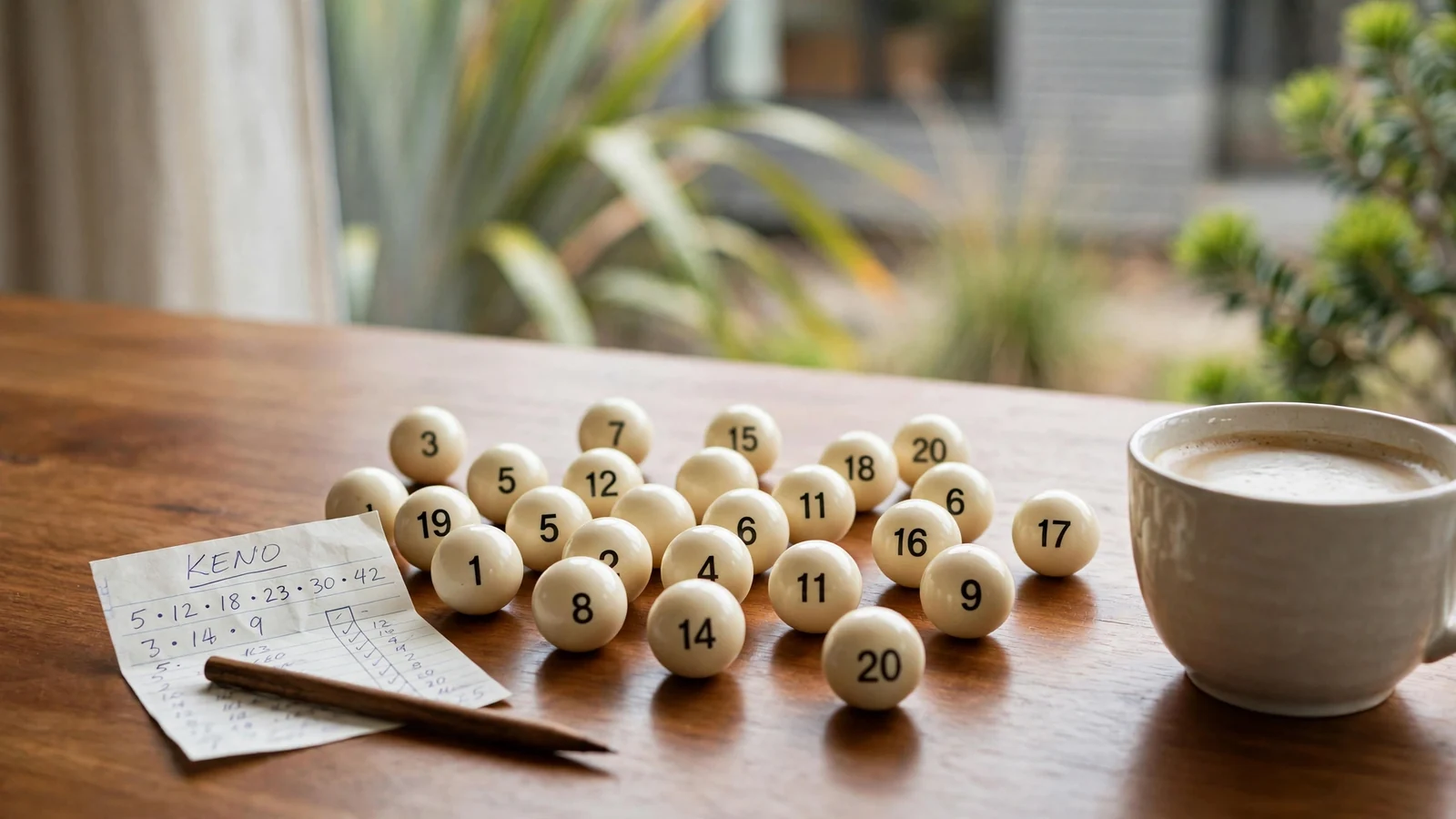
Table of Contents
- How New Zealand Keno Draws Work
- Today’s New Zealand Keno Results and Draw Times
- Live Keno Results: What ‘Live’ Means
- Daily Results: Match the Numbers to the Right Draw
- Live Results Are Not a Forecast
- New Zealand Results Versus Overseas Keno Games
- Draw Results, Number Lines and the Multiplier
- Checking Results Without Treating Numbers as a System
- Keno Results for New Zealanders in 2026
- Checking Keno Results Online and Claiming a Prize
How New Zealand Keno Draws Work
New Zealand Keno starts with a pool numbered from 1 to 80. For each drawing, 20 numbers are selected from that pool. The player makes a separate choice: a line can contain between one and ten numbers. Those two selections serve different purposes. The player’s line records the numbers entered; the draw produces the numbers against which that line is assessed.
That distinction is the basis of any Keno result. A player does not choose the 20 numbers that appear in the draw, and choosing a number does not make it more likely to be drawn. The outcome is the set selected from the full pool, while the ticket contains a smaller selection made before the outcome is known.
A Keno line can therefore be short or long within the permitted range, but it remains a selection from the same pool. The draw still produces 20 numbers. The size of the player’s line does not change how many numbers are drawn; it changes only which numbers on that ticket can be compared with the result.

The term “result” refers to the numbers produced by a completed drawing, not the numbers a player hoped to see. When a ticket is assessed, its chosen numbers are compared with that draw’s 20-number set. The comparison establishes which selections coincide. It does not turn the player’s line into a prediction or alter the draw itself.
This is why a Keno result should be read as a record of one drawing rather than as a continuation of a player’s chosen sequence. A line may contain numbers selected by hand or numbers chosen through a random-pick option, but the drawing remains a separate selection from the pool. The source of the player’s choices does not control the numbers drawn.
The same mechanics apply when looking back at previous results. Each earlier entry records the numbers selected for an individual drawing. It can show what was drawn on that occasion, but it does not change the pool or the structure of a later drawing. The rules remain a player selection of one to ten numbers and a draw of 20 from 80.


In practical terms, Keno has two number sets to keep distinct: the player’s line and the numbers drawn. Confusing them can make a result difficult to read, particularly when a ticket contains only a small part of the available pool. Keeping the two selections separate is the starting point for understanding what a result records.
Today’s New Zealand Keno Results and Draw Times
New Zealand Keno has four scheduled draws each day: 10 am, 1 pm, 3 pm and 6 pm NZST. The operator is Lotto New Zealand. These times provide the reference for identifying a result; “today’s result” is not one undifferentiated set of numbers, but the outcome associated with a particular scheduled draw.
Some descriptions say that draws occur approximately every three hours. That is a rough summary, not a precise timetable: the published schedule has four distinct times, and the gaps between them are not all the same. For checking a result, the listed draw time is the useful detail. A result labelled with the 3 pm draw, for instance, belongs to that drawing rather than to the 1 pm or 6 pm one.

Today’s results depend on the draw
A daily results page may show several outcomes under the same date. Each entry should be read with its draw time, because the date alone does not identify which result is being displayed. A record for the morning draw and one for the evening draw can both be current-day results while referring to different events.
This distinction matters when a page presents the latest outcome at the top. “Latest” means the most recent draw represented in that listing; it does not mean that every result shown on the page belongs to that draw. Earlier entries may remain visible alongside it. The draw label, not the page position or the word “today”, identifies the result being reported.
The same rule applies when results are viewed through a retailer or an online account. Keno tickets are available at Lotto NZ retailers and through MyLotto, but the channel used to view or purchase a ticket does not change the scheduled draw times. A result needs to be associated with the relevant draw, rather than treated as a general daily total.
- Check the specific draw time for each result
- Use the draw label to identify the outcome
- Associate the result with the relevant scheduled draw
- Rely on the date alone to identify a result
- Treat “today’s result” as one single set of numbers
- Use page position to determine which result is latest
Reading the daily sequence
The schedule begins with the 10 am draw, followed by the 1 pm and 3 pm draws, then the 6 pm draw. The term “tonight” ordinarily points to the evening draw in that sequence, while a result described as “today’s” could refer to any of the four. If a page does not make the draw time clear, the date by itself is not enough to establish which result it means.
“Latest” is also relative to the time at which the results are being checked. Before the day’s later scheduled draw, the most recent result may be an earlier one from that same day. Once the 6 pm draw has taken place, it is the last scheduled result for that date. This describes the order of the daily schedule; it does not establish how quickly a particular website updates after a draw.
The distinction is useful for searches framed around results from today, tonight or yesterday. These words locate a date or part of the day, but they do not replace the draw time. A result listed for yesterday should be read as an entry from one of yesterday’s scheduled drawings, not as a separate daily result that combines all four. Likewise, a request for the latest New Zealand Keno result needs a date and draw label to be unambiguous.
Previous results and dates
Previous results remain tied to their original drawing. Moving to another calendar date does not change the draw time attached to an earlier entry. A useful results record therefore gives enough context to distinguish the date and scheduled draw, especially when several entries appear together.


For a current-day check, the practical reference is the four-time schedule and the draw label shown with the result. The label establishes which scheduled outcome is being reported; the calendar date establishes when it belongs in the daily sequence. Without both pieces, “today”, “yesterday” and “latest” can describe different entries depending on when the page is viewed.
The regular timetable is straightforward: four draws, at 10 am, 1 pm, 3 pm and 6 pm NZST. The careful part is not interpreting “daily” as a single result. Each scheduled drawing has its own result, and the date alone does not merge them.
Live Keno Results: What ‘Live’ Means
“Live” describes timing, not certainty. It may refer to a draw taking place, a screen updating while information is being reported, or a result page showing the latest available status. Those are not interchangeable with a completed result. Until the draw has finished and its result is presented as final, the numbers shown should be treated as information in progress.
For New Zealand Keno, the scheduled drawings are at 10:00 am, 1:00 pm, 3:00 pm and 6:00 pm Pacific/Auckland time. That schedule gives a time reference; it does not make a result knowable in advance. A page displaying the word “live” before a drawing is complete is not evidence of the outcome. Nor does a moving display necessarily mean every number shown is already part of a confirmed result.
New Zealand Keno Schedule
Scheduled drawings take place at 10:00 am, 1:00 pm, 3:00 pm, and 6:00 pm Pacific/Auckland time.
A live update is not the same as a final result
A live draw or update concerns the process as it is happening. A completed result concerns the outcome after that process has ended. The distinction matters because a partial display cannot settle whether a particular line has matched the final set of drawn numbers. Until the result is complete, any assessment based on only the information displayed so far is provisional.
A result page can also change status over time. It may show that a drawing is underway, then display an updated set of information, and later show a completed result. The word “live” alone does not explain which stage a page has reached. The relevant detail is the status attached to the information: is the drawing still in progress, or is the result presented as complete?
This is a timing distinction, not a prediction method. A display that updates quickly does not reveal numbers before they are drawn. A result becomes useful for checking only when it relates to a completed drawing; before that point, the outcome remains unresolved.
Reading “today,” “tonight” and “yesterday”
“Today” depends on the date and time in New Zealand, not on the date shown by a service operating elsewhere. That can matter when a page or search result uses a different local time zone. The New Zealand schedule is expressed in Pacific/Auckland time, so a result described as current should be understood against that local clock.
“Tonight” is similarly a time description, not a separate draw status. It may refer to the evening drawing, but it does not establish that the draw has taken place or that its result is final. If the drawing has not finished, there is no completed result for that session to check. Once it has finished, the result should be read as the outcome of that completed drawing rather than as a live prediction.

A result from yesterday is historical, even if a page continues to display it prominently or labels it as the latest result. “Latest” and “live” are not synonyms: the latest completed result can belong to an earlier drawing, while a live update may relate to a drawing that is still underway. The date and the status both matter.
Searches for live results may also lead to pages for other places, including New South Wales. A result associated with another jurisdiction is not thereby a New Zealand Keno result. The word “live” says something about timing; it does not identify the game or establish that the information is current for New Zealand.
What to rely on when the display is unclear
A republished result can be useful as a quick reference, but it carries no guarantee and is not the basis on which a retailer will pay a prize. A live label does not change that. Where a display appears incomplete, its status is unclear, or its date does not fit the New Zealand time, it should not be treated as a final confirmation.
The practical test is straightforward: the drawing must be finished, and the result must be shown as completed for the relevant date and time. Before that, the display may be an update rather than an outcome. Afterward, it is still important to distinguish a confirmed result from a copied or republished display. “Live” describes when information is being shown; it does not, by itself, certify what the final result is.
Attention: A result presented as “live” is information in progress and should not be treated as a final confirmation until the draw is complete.
Daily Results: Match the Numbers to the Right Draw
A result belongs to a particular Keno drawing, not to the day as a whole. New Zealand has four drawings each day, so a list of today’s results may contain several separate outcomes. The useful comparison is between the drawing entered on a ticket and the result for that same drawing. Matching numbers against another result from the same date can produce the wrong conclusion, even when the figures themselves are correct.
The ticket provides the reference point. Its draw details determine which result applies; the date alone is not enough when multiple drawings take place during the day. Before comparing a line with daily Keno results, identify the drawing the ticket was entered into, then use the result associated with that drawing. A result for an earlier drawing does not settle a ticket entered into a later one, and a later result does not change the outcome of an earlier entry.
The sales cutoff is the point that decides which drawing receives a single play. A ticket completed before the relevant cutoff enters the next drawing. If that cutoff has passed, the play goes into the following drawing instead. The numbers printed on the ticket may be unchanged, but the drawing they belong to has shifted. That difference is practical, not cosmetic: the ticket must be checked against the result for its actual entry.


This is why a search for a Keno result today can be too broad to answer the important question. “Today” identifies a date, while a ticket is tied to a specific drawing. A result page or copied list should not be treated as sufficient evidence on its own. The decisive comparison is between the ticket’s draw information and the corresponding official result. Republished results carry no guarantee and are not what a retailer will pay against.
Multi-draw tickets require the same care across their entries. They play the same numbers in consecutive drawings, so each drawing has its own result to compare with those numbers. One comparison cannot stand in for the others. A ticket covering several drawings may therefore have different outcomes across those entries, even though its selected numbers remain the same. The draw details are the accounting line between them.
A practical check can be kept to three steps:
- Read the drawing information on the ticket.
- Find the result for that same drawing, rather than relying on the date alone.
- Keep the ticket as the reference for any prize check; a copied result list is not a payment document.
This approach also resolves apparently conflicting records. Two result sets for the same day need not contradict each other if they refer to different drawings. Conversely, a list with the right date but no clear connection to the ticket’s drawing is not enough to establish a match. The date narrows the search; the drawing identifies the relevant outcome.
For a ticket entered before the cutoff, the next drawing is the one to check. For a ticket purchased after the cutoff, the following drawing applies. That rule is especially important when a purchase is made near a scheduled drawing: the clock does not override the sales cutoff. A Keno result today is relevant only when it belongs to the drawing the ticket actually entered.
Live Results Are Not a Forecast
A current result records an outcome; it does not contain a signal about the next one. New Zealand Keno draws are independent, so numbers that appeared in recent games do not become more likely to appear again, and numbers absent from those games do not become more likely to return. The previous draw has no carrying balance into the next.
Independent Draws
New Zealand Keno draws are independent, meaning past results have no influence on future outcomes.
That distinction matters when reviewing keno live results. A list of recent outcomes can show what was drawn, but it cannot establish a reliable pattern for a future game. A number appearing often in a short run may look “hot”. One appearing rarely may look “cold”. Neither label changes what the next independent draw produces. Calling an absent number “due” adds an expectation, not predictive information.
What a run of results can show
Recent results can be described accurately after the event: particular numbers appeared, others did not, and the sequence had its own shape. The difficulty begins when that description is turned into a forecast. A run that looks unusual in retrospect does not imply that it will continue, reverse or balance out in the next game.
This applies whether the record is viewed as a chart, a results history or a stream of keno game results today. A visual pattern is still a record of past outcomes. Highlighting repeats, gaps or clusters can make the display easier to read, but it does not make those features predictive. A chart can organise evidence; it cannot change the process that generated it.


The same limit applies to a “favourite” number selected because it appeared in previous results. Keeping a number in a selection may make the choice consistent, but consistency is not an advantage over a fresh selection. Quick Pick and manually chosen numbers are different ways to form a line, not methods for anticipating the draw. Past results do not validate either approach.
The cost of treating history as a system
The practical risk is not that a chart exists. It is the spending decision made on the belief that the chart has found an edge. Chasing a cold number, adding plays after a miss or increasing a stake because a number seems overdue turns an unsupported forecast into a larger cost. The result remains uncertain; the money committed does not.
A useful record therefore separates observation from prediction. “This number appeared in recent results” is an observation. “It is more likely next time” is a forecast, and independence gives no basis for that conclusion. Equally, a number’s absence from the latest keno results does not establish that it is approaching a turn.
Live keno results can satisfy the need to see what happened in a particular game. They do not supply a probability shortcut for the next one. Watching outcomes arrive may make a sequence feel immediate and meaningful, but proximity is not influence: the previous result does not direct the next draw.
Financial Risk
Treating historical number patterns as a predictive system can lead to increased costs without improving the odds of winning.
Keno remains a game of chance. No app, chart, tracking method or number system improves the odds of winning. A firm spending limit set before play keeps the financial decision separate from the story built around recent numbers. The stake is a cost of entertainment, not an investment justified by a supposed trend.
New Zealand Results Versus Overseas Keno Games
New Zealand Keno is the game run by Lotto New Zealand. A result belongs to that product; it should not be treated as interchangeable with results from an overseas Keno-style game, even where the games share a name or similar presentation. The operator and the product determine which draw a published result refers to.
This distinction matters when a result page refers to Belgium. “Keno results from Belgium” may concern a different game operated for another market, not a New Zealand Lotto draw. Its numbers cannot establish the outcome of a New Zealand ticket. The country label is part of the product identification, not a minor detail that can be ignored when comparing results.
The same separation applies to casino games called Keno. An overseas casino may offer a Keno-style game with its own rules and result process. That does not make it Lotto New Zealand Keno, and the casino game’s results are not a record of New Zealand lottery drawings. Similar names do not create a shared game or a shared result.
New Zealand lottery tickets are sold through Lotto NZ retailers and MyLotto. Tickets must be bought while physically present in New Zealand. Some third-party concierge or messenger services may offer to obtain New Zealand lottery tickets for people overseas, but a specialist lottery review describes such services as independent businesses, not as services connected to Lotto NZ. That distinction affects who is responsible for the transaction; it does not turn an overseas Keno game into a New Zealand ticket.
A useful check is therefore the identity of the game and its operator. A page presenting numbers as New Zealand results should identify Lotto New Zealand Keno, rather than relying on the word “Keno” alone. If the page is about a Belgian or casino product, its numbers belong to that product unless it clearly establishes otherwise. Combining results from different games produces no meaningful New Zealand result set.
The boundary is straightforward: Lotto New Zealand Keno results concern the New Zealand lottery game; overseas Keno-style results concern separate products. They should be kept apart when checking a ticket or comparing published numbers.
Draw Results, Number Lines and the Multiplier
A Keno result contains the numbers drawn, while a ticket contains the player’s number line. These are separate sets: the draw selects 20 numbers from 1 to 80, and a player chooses a line of between one and ten numbers. The result is read by comparing the two sets and counting how many numbers on the line also appear among the drawn numbers.
The line may be chosen manually or created with Quick Pick, which selects numbers randomly. Either way, the player’s selection is fixed on the ticket. The drawn numbers are not chosen by the player, and a line does not change to match the result. A Favourite can make a selected line easier to reuse, but it remains a selection rather than a prediction.
Checking Your Ticket
Compare the numbers on your ticket line (one to ten numbers) with the 20 numbers drawn in the result.
Determine how many of your selected numbers also appear in the official draw set.
Inspect your ticket to see if a Multiplier was separately assigned to the entry.
For example, if a line contains a number that also appears in the draw, that number is a match. The total number of matches is the relevant comparison between the ticket and the result. The 20 drawn numbers do not become a player’s line, and a line with fewer selected numbers is not assessed as though it contained all 20.
The optional Multiplier is a separate ticket feature. It is assigned independently of the player’s number line, so it does not add numbers to the line or alter which drawn numbers count as matches. It also cannot be added after the ticket has been bought and does not multiply the jackpot. The result therefore has two distinct parts to check: the number-line matches and whether the ticket carries a Multiplier.
That distinction matters when reading Keno draw results today or reviewing live draw results after the numbers are shown. A matching number is not the same thing as a Multiplier, and neither should be inferred from the other. The drawn set establishes the matches; the ticket records the selected line and any separately assigned Multiplier.

A concise check is to compare the ticket’s line against the published drawn numbers, count the overlaps, then inspect the ticket for the Multiplier. The ticket, rather than a copied results display, is the record of the selections and features entered. No extra number line is implied by the draw itself: the draw supplies the comparison set, and the ticket supplies the player’s set.
Checking Results Without Treating Numbers as a System
Checking a Keno result is a comparison, not a method for improving a ticket. The result shows which numbers were drawn; a chart or app can organise past outcomes, but it cannot change the probability of a future one. Keno draws are independent. A number appearing often, rarely or not recently does not make it more or less likely to appear next.
That distinction matters when reviewing current results. A record of previous draws can describe what happened, but it cannot establish a pattern that predicts the next outcome. “Hot”, “cold” and “due” are labels applied after results have occurred. They do not alter the draw.
Quick Pick, Dip and a personally chosen line are different ways of selecting numbers, not forecasting tools. A random selection does not carry information about the next draw, and a Favourite does not gain an advantage through being reused. Repeatedly checking results or changing a line in response to a chart also does not improve the odds.
Responsible Play Check
- Set a firm spending limit before playing
- Confirm you are aged 18 or over
- Ensure you are physically present in New Zealand to purchase
- Treat the stake as entertainment cost, not an investment
A result copied to a third-party page may be useful for reference, but republished results carry no guarantee and are not the basis on which a retailer will pay a prize. The ticket remains the relevant record when checking an outcome. If a displayed result and a ticket appear inconsistent, the discrepancy should be resolved through the official Lotto NZ channel rather than by treating a copied chart as authoritative.
The same limit applies to number generators, tracking apps and systems that claim to identify a profitable sequence. They may store selections or present past draws clearly; none can make a chance-based draw predictable. A tool that presents historical data as a forecast is adding interpretation, not probability.
Keno is entertainment, not an income plan. A firm spending limit set before play keeps the cost measurable; chasing a supposed pattern makes the amount spent harder to control without improving the chance of a match. In New Zealand, lottery products can be bought or claimed only by people aged 18 or over.
Keno Results for New Zealanders in 2026
For readers checking keno results in New Zealand in 2026, this list is a reference point for the operators’ available details. The information provided does not establish which operators offer keno or publish its results.
License: Malta Gaming Authority, licence no. MGA/B2C/394/2017 N1 Casino is listed with a Malta Gaming Authority licence, number MGA/B2C/394/2017.
License: Curaçao Gaming Authority, licence no. OGL/2024/165/0185 BitStarz is listed with a Curaçao Gaming Authority licence, number OGL/2024/165/0185.
License: Tobique Gaming Commission, licence no. 0000064 Neospin is listed with a Tobique Gaming Commission licence, number 0000064.
Payout speed: 1-3 business days The supplied detail for Lamabet is a payout speed of 1–3 business days.
License: Tobique Gaming Commission, licence no. 0000091 7Bit Casino is listed with a Tobique Gaming Commission licence, number 0000091.
License: Tobique Gaming Commission, licence no. 0000002 Ricky Casino is listed with a Tobique Gaming Commission licence, number 0000002.
License: 07017519840 · Payout speed: 1-3 business days Zotabet is listed with licence number 07017519840 and a payout speed of 1–3 business days.
License: Malta Gaming Authority, licence no. MGA/B2C/370/2017 Play Grand is listed with a Malta Gaming Authority licence, number MGA/B2C/370/2017.
Payout speed: 1-3 business days The supplied detail for Wintino is a payout speed of 1–3 business days.
The details that matter when reading a New Zealand Keno result remain consistent across the year: the scheduled draw times and the date attached to a winning ticket. A result for today belongs to a particular drawing, not to the day in general. The date and draw time therefore provide the reference point for checking a ticket and tracking any prize.
Lotto New Zealand holds four Keno draws each day, scheduled for 10:00 am, 1:00 pm, 3:00 pm and 6:00 pm. These are the published times for the regular daily schedule. A list of numbers without its draw date and time is incomplete for practical purposes: it does not identify which result should be compared with a ticket.
The claim period is measured from the drawing date, rather than from the date a result is checked. A Keno prize has to be claimed within 12 months of the draw. Once that period expires, the prize is forfeited and transferred to the Prize Reserve Fund. Delaying a check does not extend the deadline, so the draw date remains relevant even after the numbers have been confirmed.
For searches made in 2026, the useful distinction is between a current-day result and the lasting conditions attached to it. The daily schedule identifies when the drawings are set to take place; the draw date anchors the claim period. Neither changes merely because the calendar year changes. A ticket’s result should be treated as tied to its own drawing, while the claim deadline follows from that drawing’s date—not from the day the ticket holder happens to review it.
That keeps the year-specific detail practical: identify the relevant scheduled draw, retain its date as the basis for any claim, and avoid treating a result as timeless once the day has passed.

Checking Keno Results Online and Claiming a Prize
Keno results can be checked online through Lotto NZ’s official channels. MyLotto is Lotto NZ’s online service, and tickets are also sold at Lotto NZ retailers. Keeping the ticket or online entry details available makes it possible to compare the result with the correct entry before treating a match as a payable prize.
A result copied to another website is not a payment instruction. Republished results carry no guarantee and are not what a retailer will pay against. The official Lotto NZ record is the relevant reference when confirming whether an entry has won. A result displayed elsewhere may be useful for a quick comparison, but it does not replace verification through the operator.
The claim period is the financial deadline that matters after a win: a Keno prize must be claimed within 12 months of the draw date. If it is not claimed by then, it is forfeited and returned to the Prize Reserve Fund. The draw date should therefore be retained with the ticket details, rather than relying on memory or a saved results page.
The available route for claiming can depend on how the ticket was purchased. Retail tickets and online entries are not the same record, so the original ticket or account entry should be kept intact until the result and any prize have been confirmed. No claim should be assumed complete simply because a number match appears on a third-party results page.
Keno tickets may be bought online through MyLotto or at Lotto NZ retailers. Players must be physically present in New Zealand to purchase tickets, and lottery products are for people aged 18 or over. The practical sequence is straightforward: identify the entry, confirm it against Lotto NZ’s result, then complete the claim within the stated 12-month period. After that deadline, the prize is no longer payable to the ticket holder.
What time are the Keno draws in New Zealand?
Traditional New Zealand Keno draws take place at 10 am, 1 pm, 3 pm and 6 pm NZST.
Doesn’t Keno draw every few minutes?
No. New Zealand Keno has four scheduled draws each day, at 10 am, 1 pm, 3 pm and 6 pm NZST.
Do Keno tools or systems actually improve your chances?
No system can predict or influence a draw: each drawing is independent, and previous results do not affect it.
How many numbers should I pick?
You can choose between one and ten numbers for a Keno line.
Where can I check my numbers after the drawing?
You can check results through Lotto NZ retailers or online through MyLotto. Match your ticket to the correct draw time and date.
Are “hot” and “due” numbers real?
They do not predict future results. Keno draws are independent, so past frequency does not make a number more or less likely in the next draw.
What are the odds of matching all 10 numbers?
A ten-number line has odds of roughly 1 in 8.9 million of matching all ten numbers.
Published by the Casino Slots Adviser NZ team.